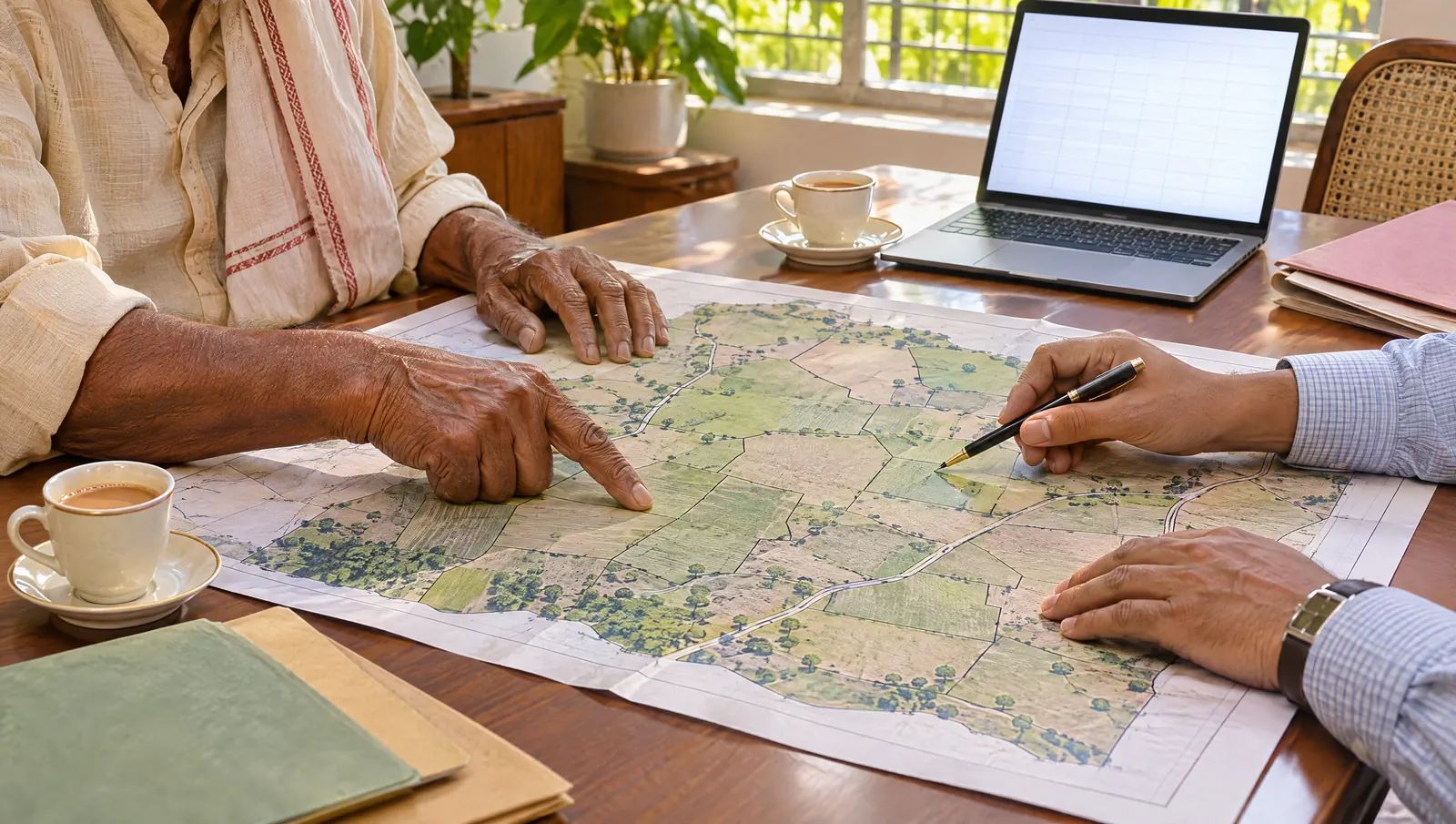
CDDMO stands for conceptualising, design, development, marketing, sales and operations. Della Townships uses the term for the end-to-end work it says it does on townships it plans with landowners; it calls itself asset-light and says most of its models let the owner keep the land (company-stated), though title to sold units passes to buyers. CDDMO describes what the developer does, not how you are paid: that is set by the deal underneath, such as a joint development agreement, a revenue share or development management. In Maharashtra, MahaRERA treats landowners with an area or revenue share as promoters, jointly liable to buyers. Get escrow, approvals duties and exit terms in writing.
CDDMO stands for conceptualising, design, development, marketing, sales and operations. It is the term Della Townships uses for the work it says it does on a township, from the first idea to running the finished place, on land it partners on with the owner (company-stated).1 CDDMO describes services, not a legal structure. How you are paid, what you own and what you risk are set by the agreement underneath it.
What is the CDDMO model in real estate?
DEVELOPER-STATED
CDDMO is a developer taking a township through six stages, from concept to day-to-day operation, in partnership with the landowner. Della Townships describes it as its end-to-end service (company-stated).1
Della Townships’ website says it offers “end-to-end Conceptualising, Design, Development, Marketing, Sales, and Operations (CDDMO)”.1 Here is what each stage covers, and what the law adds.
| Letter | Stage | What Della Townships says it brings (company-stated) | What the law or your agreement adds |
|---|---|---|---|
| C | Conceptualising | A theme and concept for the township; it says it shares master plans, concept decks and financial models1 | Ask who owns the plans and the financial model if the deal ends |
| D | Design | Masterplanning and design1 | The design must meet the planning rules for your land; approvals are not guaranteed |
| D | Development | Approvals and construction. It says it does not fund construction capital expenditure, and that it “structures institutional funding where required”1 | Who applies for approvals, who pays for construction and who covers overruns must be written into the agreement |
| M | Marketing | Branding and launch | No promoter may advertise, market, book or sell units in a project that must be registered under RERA until it is registered (RERA s.3(1))2 |
| S | Sales | Selling the homes or plots | Buyer money is subject to RERA’s separate-account rule (see below)2 |
| O | Operations | It says hospitality, adventure and lifestyle assets are operated by Della Resorts & Hospitality1 | Until the residents’ association takes over maintenance, the promoter must provide and maintain essential services on reasonable charges (RERA s.11(4)(d))2 |
Della Townships describes itself as asset-light. It says it works with landowners through joint development agreements, revenue share, equity partnerships and hybrid models; that most of these let the landowner keep ownership of the land; and that it typically looks for 100 contiguous acres or more with clear marketable title. It lists 13 township collaborations and says they are going through approvals (company-stated, as of 27 November 2026).1 Keeping ownership can only cover land not yet sold: under RERA, the promoter must convey each sold home or plot to its buyer by registered deed, and the common areas to the buyers’ association or the competent authority (s.17(1)).2
When we searched MahaRERA’s register by project name on 27 November 2026, none of the township collaborations Della Townships lists in Maharashtra appeared.3 We have not searched other states’ registers. This guide names none of the collaborations.
What is asset-light real estate development?
An asset-light developer builds on land it does not own. It partners with the owner instead of buying, so it needs less capital and carries less land risk.
Arvind SmartSpaces’ 2023-24 annual report gives the reasons: joint developments let a developer expand without a significant capital outlay, reduce land-related risks, and can speed up timelines because the land is typically ready for development. The same report says the company wants more projects on land it owns outright, so asset-light is a choice, not a one-way trend.4
CDDMO is one way of describing what an asset-light developer contributes instead of land. Our guide to asset-light real estate development covers the model in full.
How is CDDMO different from a JDA, a revenue share, development management or a sale?
A JDA, revenue share, DM contract or sale sets how you are paid and what you own. CDDMO describes what the developer does on top of that deal.
| Outright sale | Joint development (area share) | Revenue share | Development management (DM) | CDDMO, as Della Townships describes it | |
|---|---|---|---|---|---|
| What you give | The land, permanently | Development rights, and in some agreements an undivided share in the land5 | Development rights | You keep the land and the project; the developer works under a contract5 | Rights under whichever deal is chosen; most of its models let you keep ownership (company-stated)1 |
| Who holds the land title | The buyer (usually the developer), from the registered sale deed | You, until you transfer an undivided share to the developer (in some agreements)5 or to buyers. Sold homes or plots, with a share of the common areas, pass to the buyers and their association by registered conveyance (RERA s.17(1))2 | You, until sold homes or plots are conveyed to buyers and the common areas to their association (s.17(1))2 | You, until the same conveyances to buyers (s.17(1))2 | Set by the deal underneath. “Keeping ownership” can cover only land not yet sold12 |
| What you get | The sale price | A share of the built area or plots, sometimes with payments or deposits5 | A percentage of sale proceeds6 | What the project earns, after the developer’s fee and the project’s costs | Set by the deal underneath: JDA, revenue share, equity or hybrid1 |
| How the developer earns | It owns the land and the project | From its own share of the project5 | From its share of sale proceeds6 | Income under the agreement with the landowner5 | Set by the deal underneath |
| When you are paid | At the sale | When you sell your share of the units (once the project is registered), or when they are handed over to you if you keep them, plus any payments or deposits the agreement sets57 | As buyers pay, on the schedule in your agreement | As the project earns | Set by the deal underneath |
| Your RERA position | None, once sold | In Maharashtra, a promoter, jointly liable with the developer7 | In Maharashtra, a promoter, jointly liable with the developer7 | Likely a promoter yourself, because the project is yours2 | Depends on the deal underneath; see the RERA section below |
There is no standard split in any of these deals, and we do not quote typical percentages: no reliable public dataset of agreed terms exists. Our guides to joint development agreements and JDA vs revenue share vs selling your land explain each option in detail.
Who carries the risk and the money at each stage?
A project that must register under RERA cannot be marketed or sold until registered, so the agreement decides who funds design and approvals. Then RERA ring-fences most buyer money.
Small projects are exempt from registration: land of 500 sq m or less, or eight apartments or fewer across all phases, unless the state has lowered these limits (s.3(2)(a) and proviso).2
| Stage | Where the money comes from | What can go wrong for you | Get in writing |
|---|---|---|---|
| Concept and design (C, D) | Whoever the agreement says. No booking or sale, and so no buyer money, before registration (s.3(1))2 | Plans that do not get approved or do not sell | Who pays for studies and design, and who owns them if the deal ends |
| Approvals (D) | As above | Delay or refusal, with your land tied up | Who applies, who pays fees, deadlines, and your right to exit if approvals fail |
| Registration, marketing and sales (M, S) | Buyers’ payments. 70% of the amounts realised from buyers must go into a separate account in a scheduled bank, to cover construction and land costs only, withdrawn in proportion to completion as certified by an engineer, an architect and a chartered accountant (s.4(2)(l)(D))2 | Slow sales, heavy discounts, or, under a revenue share, under-reported sales | How and when your share is paid, your right to see collections, and any say on prices |
| Construction (D) | The separate account, plus whatever funding the agreement sets. Della Townships says it does not fund construction capital expenditure and arranges institutional funding where required (company-stated)1 | Cost overruns, funding gaps, delay claims from buyers that may reach you as a promoter | Who funds overruns, whether your land or share will be offered as security to lenders, and what indemnity you get |
| Operations (O) | Maintenance charges and the income of any operated assets | Weak upkeep, or a long operating contract you cannot end | Who operates what, for how long, on what fees, and the handover to the residents’ association (s.11(4)(d))2 |
Is the landowner a promoter under RERA in a CDDMO deal?
VERIFIED
In Maharashtra, yes, if you take a share of the area or revenue: MahaRERA treats such landowners as promoters, jointly liable with the developer. Elsewhere it depends on your role.
RERA’s definition of promoter covers a person who constructs or causes to be constructed a building of apartments for sale, or develops land into plots for sale, and any person who acts as a developer or claims to act as the holder of a power of attorney from the landowner. Where the person who builds and the person who sells are different, both are deemed promoters and are jointly liable for the Act’s functions and responsibilities (s.2(zk) and Explanation).2 The only central amendment we found since the Act was passed, the Jan Vishwas (Amendment of Provisions) Act 2026, changed section 68, a penalty on buyers, according to two legal summaries (as of 27 November 2026).89
So a developer that runs design, construction, marketing and sales will normally be a promoter. Whether you are one too depends on the deal underneath:
- Area or revenue share, in Maharashtra. MahaRERA’s Circular 12/2017 treats landowners entitled to a share of the area or revenue as promoters. They are named as such at registration, the agreement between the promoters is uploaded for public viewing, and a landowner who takes a share of the area should open a separate bank account for 70% of the sale proceeds from buyers of that share. Each landowner promoter’s liabilities follow the written agreement, but for withdrawals from the project’s designated account, all promoters’ obligations are on a par.7
- Development management. You own the project and cause it to be built for sale, so you are likely a promoter yourself, whatever the contract says about who does the work.2
- Outside Maharashtra. The answer depends on the state and on your role in the project. Our guide Is the landowner a promoter under RERA? sets out how courts have approached it.
Do not assume your agreement with the developer limits what buyers can claim from you.27 Ask a property lawyer in your state before you sign.
What should a landowner get in writing before signing a CDDMO deal?
Get the deal structure, your RERA status, the money mechanics, approvals duties and your exit route written into the agreement. A description of services is not enough on its own.
- The structure. Which deal sits under the CDDMO service: JDA, revenue share, development management, equity or a hybrid? What does each stage of the service cost you, if anything?
- Your RERA status. Will you be named as a promoter at registration? What could you owe buyers, and what indemnity does the developer give you?
- Escrow and payments. How buyer money reaches the RERA separate account,2 whether you need your own account for your share (in Maharashtra, if you take area),7 when your share is paid, and your right to see collections and sales data.
- Approvals. Who applies, who pays, the deadlines, and what happens if approvals are refused or delayed.
- Funding. Who funds construction and any overruns, and whether your land or share will be offered as security. If a developer says it does not fund construction, as Della Townships says of itself, ask who will, and on what terms.1
- Marketing. For a project that has to be registered, no marketing or bookings before RERA registration,2 and your rights over pricing and the brand used.
- Operations. Which company will run the finished township, under what contract, for how long, and how maintenance passes to the residents’ association.
- Exit. The events that let either side end the agreement, what happens to approvals and plans if it ends, and limits on any power of attorney you give. Where the developer acts for you under a power of attorney and has its own interest in the land, as under many JDAs, the law may not let you end that authority to the prejudice of its interest unless the contract expressly allows it (Indian Contract Act 1872, s.202).10 Where the developer has no such interest, ending a fixed-term arrangement early without sufficient cause may still mean paying it compensation (s.205).11
- Agency. If the developer signs contracts or deals with buyers in your name, as it may under development management, it acts as your agent: what it agrees within the authority you give it binds you (Indian Contract Act 1872, s.226).12
- Track record. The developer’s registered and completed projects on RERA, with promised and actual completion dates.
- Tax. How and when you will be taxed under the chosen structure. Ask your chartered accountant to model your deal before you sign.
Then run any offer through our sale, JDA or revenue-share comparison tool and the landowner’s due-diligence checklist. Our land and township glossary explains the terms used here.
Which developers partner with landowners instead of buying land?
Della Townships, above, says it is asset-light and partners with landowners (company-stated).1 Godrej Properties, Arvind SmartSpaces, Kolte-Patil and Puravankara describe joint development or development-management work in their own filings.
- Godrej Properties. Its 2023-24 integrated report says it manages risk by “diversifying through owned projects, joint ventures, residential platforms, and development management services”. It acts as development manager on land owned by Godrej & Boyce, says it “enters into Development and Project Management agreements with landowners”, and has development agreements under which it pays landowners “certain payments/ deposits” and shares “built up area/ revenue” with them “in exchange of undivided share in land”.5
- Arvind SmartSpaces. Its 2023-24 annual report describes projects taken up on joint development, revenue-share and development-management models, including development management for a subsidiary of Arvind Ltd.13 It also plans to raise the share of projects on land it owns outright.4
- Kolte-Patil Developers. Its 2025-26 annual report says “the JV and JDA model will continue to be deployed as a capital-efficient instrument for pipeline expansion”, next to “outright and redevelopment acquisition”, and refers to “the Company’s asset-light strategy”.14
- Puravankara. Its 2025-26 annual report lists two joint developments in Bengaluru among the year’s additions, next to a land purchase, a joint venture and redevelopment projects. It records amounts payable to landowners under joint development arrangements “in lieu of which, the Company has agreed to transfer certain percentage of constructed area/ revenue proceeds”, and lists “joint development arrangements and counterparty obligations” among its land risks.6
None of the filing pages cited here uses the term CDDMO. The list is illustrative, not a ranking, and being asset-light says nothing on its own about how well a developer delivers. Judge each one on its RERA record and its agreements.
- Della Townships India, website home page and FAQ (answers 8, 9, 15, 18, 19, 26, 27 and 28) (company-stated; not linked because the page carries marketing claims), Della Townships India. Accessed 27 Nov 2026.
- Real Estate (Regulation and Development) Act 2016, ss.2(zk) and Explanation, 3(1), 3(2)(a), 4(2)(l)(D), 11(4)(d) and 17(1) (unofficial copy of the Act text, as reproduced by Haryana RERA), Haryana RERA, Acts page. Accessed 27 Nov 2026.
- MahaRERA registered-project search, project name 'Della', State Maharashtra, searched 27 Nov 2026, MahaRERA. Accessed 27 Nov 2026.
- Arvind SmartSpaces, Annual Report 2023-24, page 30 (reasons for joint developments; portfolio mix), Arvind SmartSpaces. Accessed 27 Nov 2026.
- Godrej Properties, Integrated Report 2023-24 (filed with the stock exchanges, 3 Jul 2024): Management Discussion and Analysis (brand; 'Threats, Risks and Concerns'), standalone material accounting policies (revenue recognition) and note 50(c)(iii) (PDF pp.114, 117, 173 and 201) (not linked: the report names planned locations), Godrej Properties, via the National Stock Exchange of India filing archive. Accessed 27 Nov 2026.
- Puravankara Ltd, Annual Report 2025-26 (filed with the stock exchanges, 3 Sep 2026): land bank and pipeline (PDF p.42), risk management (p.44) and standalone note on other liabilities (p.243) (not linked: the report names planned locations), Puravankara, via the National Stock Exchange of India filing archive. Accessed 27 Nov 2026.
- MahaRERA Circular No. 12/2017 (4 Dec 2017): land owners/investors having area/revenue share to be treated as promoter, MahaRERA. Accessed 27 Nov 2026.
- RERA section 68 amendment 2026: allottee penalty update (Jan Vishwas (Amendment of Provisions) Act 2026, RERA provisions in force 7 May 2026) (secondary), SCC Online. Accessed 27 Nov 2026.
- Jan Vishwas and the wrong end of RERA (column) (secondary), Bar & Bench. Accessed 27 Nov 2026.
- Indian Contract Act 1872, s.202 (unofficial copy of the bare-act text), advocatekhoj. Accessed 27 Nov 2026.
- Indian Contract Act 1872, s.205 (unofficial copy of the bare-act text), advocatekhoj. Accessed 27 Nov 2026.
- Indian Contract Act 1872, s.226 (unofficial copy of the bare-act text), advocatekhoj. Accessed 27 Nov 2026.
- Arvind SmartSpaces, Annual Report 2023-24, page 29 (joint development, revenue-share and development-management projects) (not linked: the report names planned locations), Arvind SmartSpaces. Accessed 27 Nov 2026.
- Kolte-Patil Developers Ltd, Annual Report 2025-26 (filed with the stock exchanges, 3 Jul 2026): managing director's statement (PDF p.19), promoter's statement (p.23) and management discussion and analysis (p.55) (not linked: the report names planned locations), National Stock Exchange of India (filing archive). Accessed 27 Nov 2026.
This guide explains how these structures generally work. It is not legal or tax advice for your situation. Report an error · Editorial policy