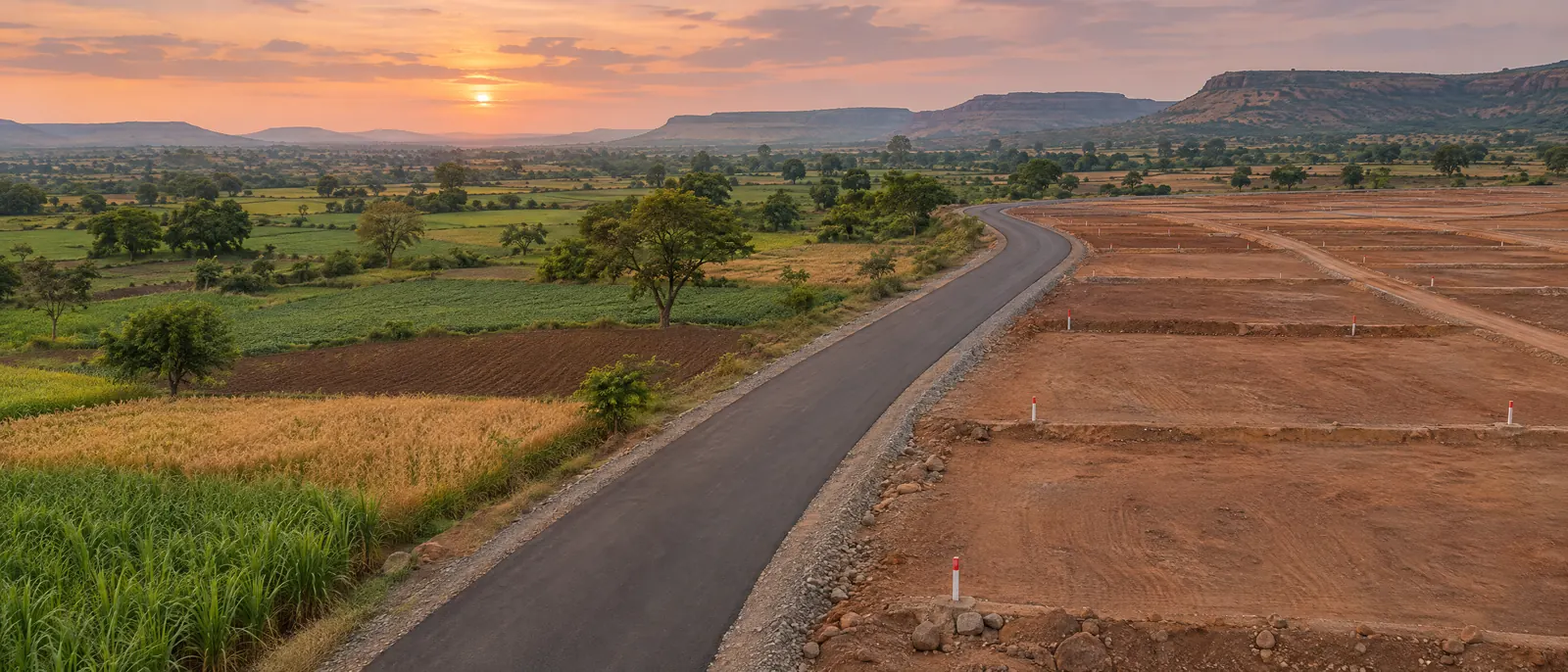
In Maharashtra, since 31 December 2025, land whose use is allowed under a development or regional plan no longer needs the Collector's separate NA permission; a one-time premium, collected with development permission, replaces annual NA tax. Gujarat still requires the Collector's permission under section 65 of its Land Revenue Code, and treats it as granted if the Collector does not decide within three months. Telangana's NALA Act charges a conversion tax at rates the State prescribes; owners apply on the Bhu Bharati portal. Madhya Pradesh lets the owner self-assess, pay the diversion premium and inform the SDO. In Maharashtra and Gujarat, tenancy laws also restrict who may buy agricultural land.
Agricultural land cannot simply be built on. It first has to be converted, or “diverted”, to non-agricultural (NA) use, and in some states the law also limits who may buy it in the first place. For a landowner, conversion is often the first sign of whether a township is realistic, and how long the approvals will take.
This guide covers four states: Maharashtra, Gujarat, Telangana and Madhya Pradesh. Rules change often: confirm the current position with a lawyer in the state before relying on it.
At a glance
| State | The law | Who decides | How it works | Charge |
|---|---|---|---|---|
| Maharashtra | Land Revenue Code 1966, ss.42 and 47, as substituted from 31 Dec 2025 | The planning authority, through development permission or building-plan approval | No separate NA permission where the use is allowed under a draft or final development or regional plan, or the development control regulations | One-time premium on the current Annual Statement of Rates value: 0.1% for up to 1,000 m², 0.25% for above 1,000 and up to 4,000 m², 0.5% above 4,000 m² |
| Gujarat | Land Revenue Code 1879, s.65 | The Collector | Application to the Collector; treated as granted if there is no decision within three months | Conversion tax under section 67A, at rates the State sets; a premium on new and restricted tenure land. We do not quote rates. |
| Telangana | Agricultural Land (Conversion for Non-Agricultural Purposes) Act 2006 (NALA), as amended in 2020 | The Tahsildar | Apply and pay on the Bhu Bharati portal | Conversion tax at rates the State Government prescribes; we do not quote a rate |
| Madhya Pradesh | Land Revenue Code 1959, s.59, and the 2018 diversion rules | Owner self-assesses; the SDO checks within 30 days | Pay the premium and revised land revenue, then inform the SDO in Form-I | Premium at rates the State notifies each year, plus revised land revenue |
Maharashtra: a new system from 31 December 2025 VERIFIED
The Maharashtra Land Revenue Code (Second Amendment) Act 2025 (Maharashtra Act LVII of 2025, published 31 December 2025) changed conversion significantly.1 The Act names no separate start date, so under the state’s General Clauses Act it took effect on the day the Governor’s assent was first published in the Gazette.2 Under the new sections 42 and 47:1
- Where the intended use is allowed under a draft or final development plan or regional plan, or under the development control regulations or other rules and orders made under the planning law, the Collector’s NA permission is no longer needed. The planning authority’s development permission or building-plan approval is enough, and the revenue records are then updated.
- Sections 42A to 42D, which created the earlier “deemed NA” routes, were deleted, along with sections 44, 44A, 45 and 46.
- Annual NA tax is replaced by a one-time premium, which the planning authority collects before it grants permission: 0.1% of the current market value under the Annual Statement of Rates for up to 1,000 m², 0.25% for above 1,000 and up to 4,000 m², and 0.5% above 4,000 m². The separate conversion tax (section 47A) is also abolished.
- Land already converted to NA use pays a one-time premium in place of annual NA tax, valued at the 2001 rates (if converted by 31 December 2001) or the rates for the year it was converted.
- A government resolution of 10 February 2026 (Revenue and Forest Department, No. NAP-2025/Pra.Kra.177/Jamin-01A) says annual NA tax is no longer charged and waives arrears of annual NA tax up to the amendment. Under the resolution, owners of land already converted must pay the one-time premium within one year of the resolution, that is by February 2027; after that, it directs officers to recover the premium with penalty and interest.3
- Development permission does not change the land’s occupancy class: restrictions on Class II land still apply.
- The State can exempt projects of public purpose, or in the public interest, from the premium by notification in the Gazette.
Three questions the law leaves open, which your lawyer should answer for your land:
- How the slabs apply. The Act sets a rate “for an area” in each band. It does not say whether a 5,000 m² plot pays 0.5% on the whole area or each band’s rate on the part of the plot in that band. The government’s February 2026 resolution describes the rates by plot size (for example, 0.5% “for a plot” above 4,000 m²), which points to the whole-plot reading, but a resolution does not amend the Act.3
- Land the plan does not allow. The new section 42 sets out no Collector-permission route for land where the plan does not permit the intended use. If that is your land, ask what route, if any, remains.
- Which year’s rates apply to land converted since 2002. For land converted to NA use from 1 January 2002 until the 2025 amendment, the Act values the one-time premium at the Annual Statement of Rates for the year the land was converted. The February 2026 resolution instead uses the rates for the date the development or building permission was given. The two can give different amounts. Before you pay, ask your lawyer which basis applies to your land.13
How the one-time premium applies to integrated townships, which had their own NA concessions under the township regulations, is a question for your lawyer. See our explainer on Maharashtra’s township rules.
Who can buy agricultural land in Maharashtra VERIFIED
In most of Maharashtra, tenancy law makes a sale of agricultural land to someone who is not an agriculturist invalid unless the Collector permits it or the Act makes an exception (section 63 of the Maharashtra Tenancy and Agricultural Lands Act).4 That Act covers the former Bombay-State area; Marathwada and Vidarbha have equivalent laws, which were amended in the same way.5
Since 1 January 2016 the restriction does not apply to land inside municipal corporation or municipal council limits, in the area of a special planning authority or new town development authority, or zoned for residential, commercial, industrial or other non-agricultural use in a draft or final regional plan or town planning scheme. A buyer who is not an agriculturist must put such land to that use within five years. The Collector can extend this by up to five more years, on charges of 2% of market value a year. If the land is still unused, the Collector takes it back.5
Section 63-1A separately allows land to be sold, without the Collector’s permission, to anyone (farmer or not) who will use it for bona fide industry or for an Integrated Township Project. The land must lie in an agricultural zone of a regional plan or town planning scheme that permits industrial use, in an area with no such plan, or in an area taken over by a private developer for an Integrated Township Project. The section does not apply in notified eco-sensitive zones. Land bought for industry must be put to that use within five years, extendable to ten on payment of charges, or the Collector can take it back.56 The five-year condition in the statute is written for industrial purchases. Ask your lawyer what conditions apply to a township purchase, including any set in the township’s own approval.
A 2026 amendment (in force from 15 April 2026) limits these purchases to Occupancy Class I land, requires the buyer to pay the one-time conversion premium under the Land Revenue Code, and allows a further extension of up to three years for industrial land, on a premium of 10% of market value. That extension is for delays beyond the buyer’s control, such as litigation or land assembly. The amendment also requires the State Government’s prior approval before the Collector permits the later sales and changes of use that section 63-1A allows.7
Gujarat
- The Collector’s permission. An owner who wants to use agricultural land for another purpose applies to the Collector under section 65 of the Gujarat Land Revenue Code 1879. If the Collector does not give a decision within three months, permission is treated as granted. The three months run from the Collector’s written acknowledgement, if it is sent within seven days, and otherwise from the date the application was received.8
- What the Collector may look at. In November 2026 a single judge of the Gujarat High Court restated that, under section 65, the Collector checks whether the applicant occupies the land and whether it is held for agriculture, not who owns it. The Collector had twice refused the applicant’s NA applications on tenancy-law grounds, the second time after the Court had quashed the first refusal; the Court quashed the second refusal, sent the application back to be decided within the statutory period, and ordered the Collector to pay ₹1 lakh in costs from his own salary.9
- Who can buy. Gujarat’s tenancy law (section 63 of the tenancy Act of 1948 as it applies in Gujarat) makes a sale of agricultural land to someone who is not an agriculturist invalid, unless the Collector permits it or the Act makes another exception.10
- Premium. Land held on new and restricted tenure (which cannot be sold or divided without the Collector’s approval) can be converted to old tenure on payment of a premium based on the jantri value, under Revenue Department resolutions, according to a 2017 audit report on Gujarat by the Comptroller and Auditor General of India.11 We have not seen the current resolution, so we do not quote a rate; ask the Collector’s office or your lawyer.
- Conversion tax. The same audit report records that section 67A of the Code charges a conversion tax, at prescribed rates, when agricultural land is put to non-agricultural use. We have not seen the current rates, so we do not quote one.11
Telangana
- Conversion is governed by the Telangana Agricultural Land (Conversion for Non-Agricultural Purposes) Act 2006, known as NALA. Section 3 requires prior permission before agricultural land is put to non-agricultural use, and section 4 levies a conversion tax.12
- A 2020 amendment (Telangana Act 19 of 2020) replaced the fixed rate (3% of basic value, 2% in the Greater Hyderabad area) with rates the State Government prescribes from time to time, and made the Tahsildar the deciding officer in place of the Revenue Divisional Officer. Applicants file an affidavit that the land is not affected by the land-ceiling, assigned-lands or scheduled-areas laws. If the land is already in non-agricultural use without permission, a penalty of 50% of the tax is added. We have not found the order that sets the current rate, so we do not quote one.1213
- Applications are made on the Bhu Bharati portal, launched on 14 April 2025 under the Bhu Bharati Act 2025 in place of Dharani. It started as a pilot in three mandals, with all districts scheduled to follow from 2 June 2025.14 The fee is paid online, the applicant books a slot and uploads an undertaking, and the portal sends the application to the Tahsildar for processing.15
- The 2020 amending Act comes into force on a date the government notifies. We have not seen that notification, but the portal already sends NALA applications to the Tahsildar, as the amendment provides.1315
Madhya Pradesh
- Since 25 September 2018, the owner diverts land by self-assessment under section 59 of the MP Land Revenue Code and its 2018 rules: calculate and pay the premium and revised land revenue, then inform the Sub-Divisional Officer in Form-I.16
- The SDO checks the calculation within 30 days and can raise a demand, with interest and penalty, if the intimation is missing or wrong. Land revenue is reassessed from the date of diversion, and the land records (other than the record of rights) are updated once the SDO confirms the calculation, or after 30 days, whichever comes first.16
- The premium is charged at rates the State notifies each year in a schedule to the rules.16
- Before diverting, the owner must make sure the new use complies with the laws that govern the land. The rules give no permission to change the use against those laws, or against sub-sections (6-ee) and (7-b) of section 165 of the Code.16
What to check before you convert
- The plan zone first. Conversion follows planning. In Maharashtra the new rules turn on whether the plan allows your use, and in Madhya Pradesh the owner must check that the use complies with the law. If the plan does not allow residential or township use on your land, conversion will not fix that.
- Tenure and occupancy class. Class II or restricted-tenure land carries extra conditions in both Maharashtra and Gujarat. Find out which class your land is in before you price a deal.
- Land already converted in Maharashtra. If your land was converted before 31 December 2025, check the one-time premium due under the 2025 amendment, which rates it is valued at, and the February 2027 deadline set by the February 2026 resolution, with the Tahsildar’s office or your lawyer.
- Who may buy. If a developer or other buyer who is not a farmer will acquire the land, ask your lawyer which exception or Collector’s permission covers the sale, and what deadline for use comes with it.
- Title and records. Every survey number, owner and mutation entry has to be in order. Our due-diligence checklist lists what to gather.
- Who pays. In a joint development, the agreement should say whether you or the developer pays conversion charges. It affects your share: see our JDA explainer.
- Timing. Who pays the premium, and when, can depend on whether you convert before or after choosing a partner. Agree the order with your lawyer, and ask a chartered accountant about any tax effect.
- Maharashtra Land Revenue Code (Second Amendment) Act 2025, Mah. Act LVII of 2025, Maharashtra Government Gazette Extraordinary Pt VIII, 31 Dec 2025 (gazette text in PRS compilation of the Code, pp.197–199), Government of Maharashtra, via PRS Legislative Research. Accessed 27 Nov 2026.
- Bombay General Clauses Act 1904 (now Maharashtra General Clauses Act), s.5: coming into operation of Maharashtra Acts (statute text, mirror), Indian Kanoon. Accessed 27 Nov 2026.
- Government Resolution No. NAP-2025/Pra.Kra.177/Jamin-01A, Revenue and Forest Department, Government of Maharashtra, 10 Feb 2026 (Marathi; GR code 202602101741321319), paras 5, 10 and 11 (para 11: valuation of land converted from 2002), Government of Maharashtra (GR portal). Accessed 27 Nov 2026.
- Maharashtra Tenancy and Agricultural Lands Act 1948, s.63: transfers to non-agriculturists barred, with the Collector-permission proviso (statute text, mirror), Indian Kanoon. Accessed 27 Nov 2026.
- Mah. Act I of 2016 (tenancy laws amendment), Maharashtra Government Gazette, 1 Jan 2016: s.63(1C) and s.63-1A (gazette text in PRS compilation of the Act, pp.110–122), Government of Maharashtra, via PRS Legislative Research. Accessed 27 Nov 2026.
- Kamlakar Bhalchandra Khaladkar v. State of Maharashtra, Bombay High Court, WP 9748/2023, 11 Sep 2025 (sets out s.63-1A), Indian Kanoon (judgment). Accessed 27 Nov 2026.
- Maharashtra Tenancy and Agricultural Lands Laws (Amendment) Act 2026, Mah. Act XVIII of 2026, Maharashtra Government Gazette, 15 Apr 2026, Bombay High Court library. Accessed 27 Nov 2026.
- Gujarat Land Revenue Code 1879 (Bombay Land Revenue Code as applied in Gujarat), s.65 (statute text, mirror), Indian Kanoon. Accessed 27 Nov 2026.
- Bhumikaben v. Collector, Ahmedabad, Gujarat High Court (M.K. Thakker J), SCA 13992/2026, order of 5 Nov 2026, LiveLaw (judgment PDF). Accessed 27 Nov 2026.
- Vinodchandra Sakarlal Kapadia v. State of Gujarat, Supreme Court, Civil Appeal 2573/2020, 15 Jun 2020 (sets out s.63 of the tenancy Act as it applies in Gujarat, with the Collector-permission proviso), Supreme Court of India. Accessed 27 Nov 2026.
- Report No. 3 of 2017, Revenue Sector, Government of Gujarat, ch. 3 (Land Revenue), para 3.2 and fn 2 (premium on new and restricted tenure land) and para 3.3 (conversion tax under s.67A) (government audit report), Comptroller and Auditor General of India. Accessed 27 Nov 2026.
- Telangana Agricultural Land (Conversion for Non-Agricultural Purposes) Act 2006, ss.3–5, text as last updated 10 Jan 2020, before the 2020 amendment (statute text, mirror; the India Code copy could not be opened), Indian Kanoon. Accessed 27 Nov 2026.
- Telangana Agricultural Land (Conversion for Non Agricultural Purposes) (Amendment) Act 2020, Act No. 19 of 2020, Telangana Gazette Pt IV-B Extraordinary No. 19, 16 Oct 2020, Government of Telangana, via PRS Legislative Research (Gazette scan). Accessed 27 Nov 2026.
- Report on the launch of the Bhu Bharati portal on 14 April 2025, NIC Telangana. Accessed 27 Nov 2026.
- Bhu Bharati: Application for NALA, user manual (2025), Government of Telangana. Accessed 27 Nov 2026.
- Madhya Pradesh Bhu-Rajaswa Sanhita (Bhu-Rajasva Ka Nirdharan Tatha Punarnirdharan) Niyam 2018, notification F-2-12/2018/VII/Sec.6 of 28 Sep 2018, made under ss.59 and 60 of the MP Land Revenue Code (rules text, mirror), Indian Kanoon. Accessed 27 Nov 2026.
This guide explains how these structures generally work. It is not legal or tax advice for your situation. Report an error · Editorial policy