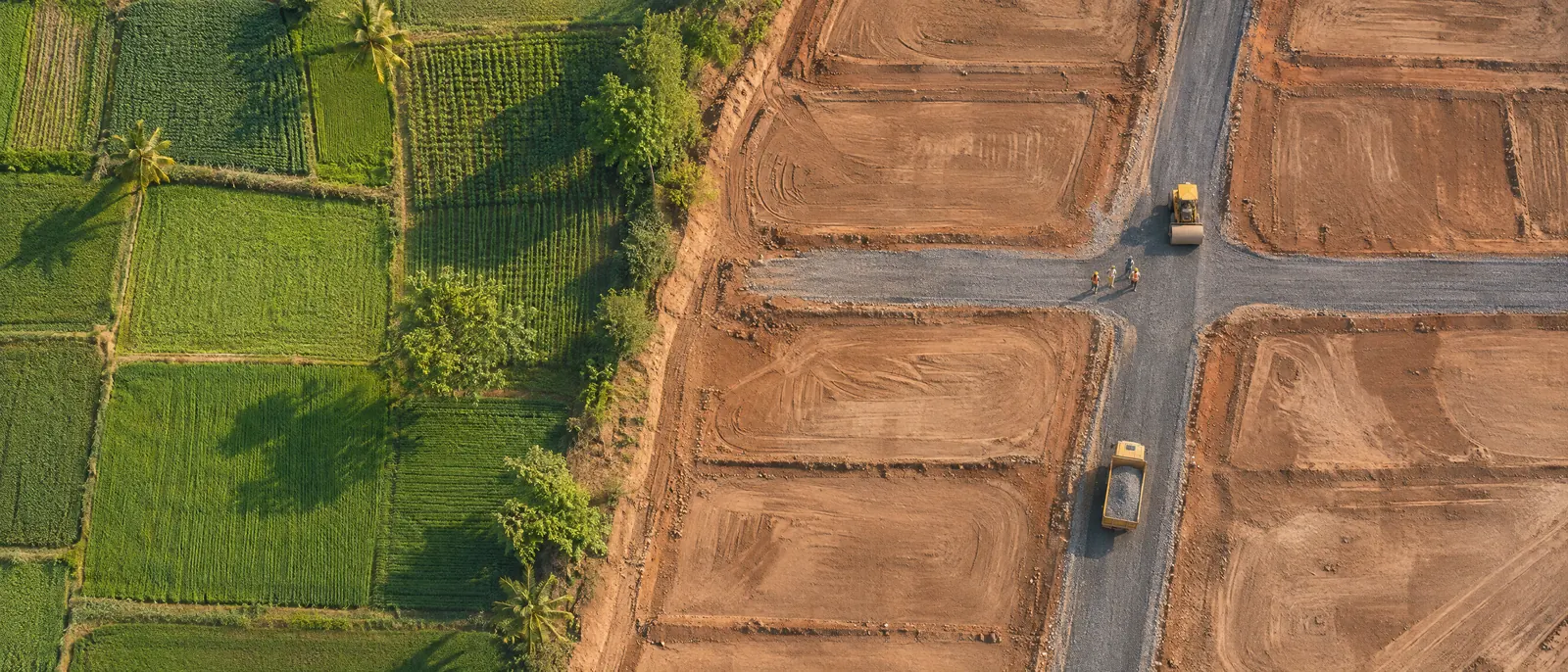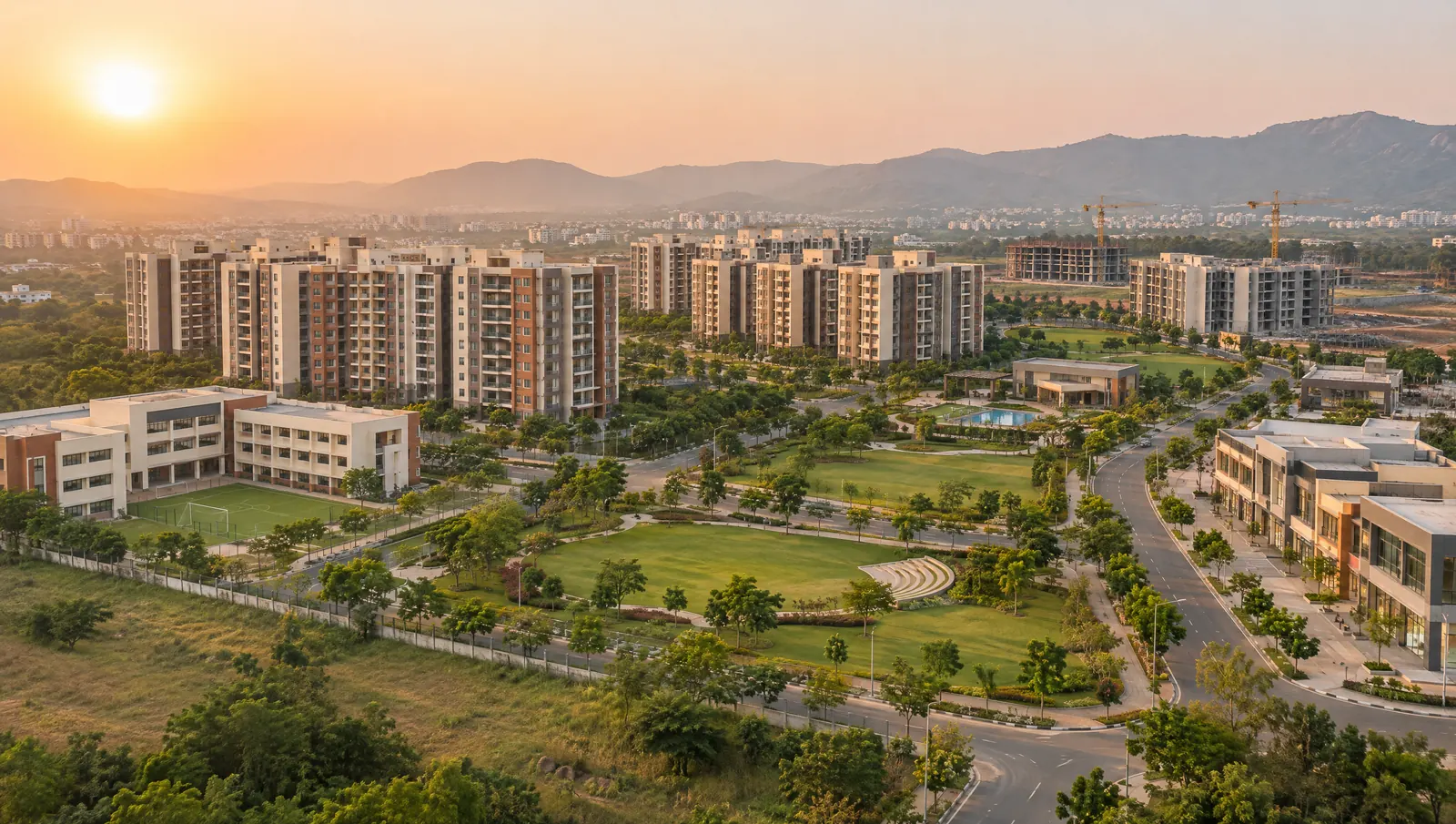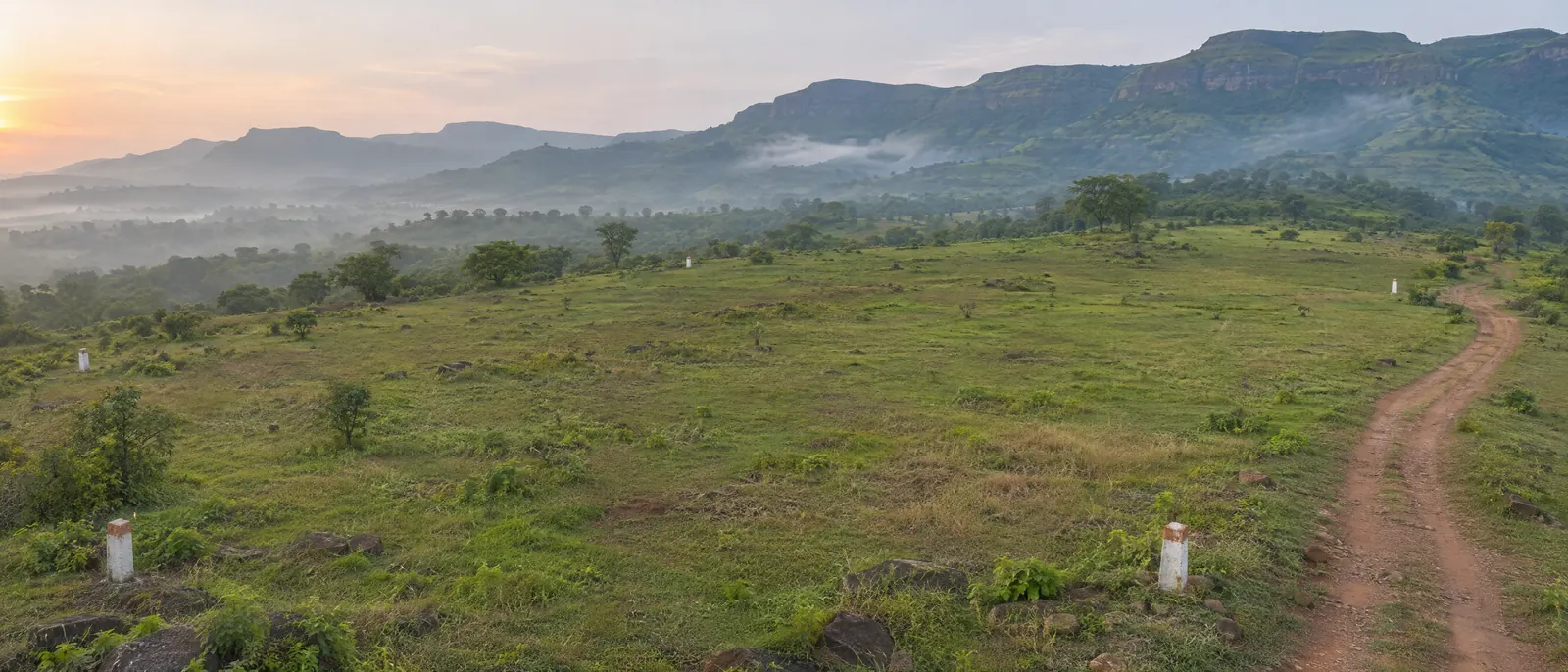
Developing 100 acres follows six stages: clean up the title; confirm what the planning rules allow on the land; check conversion to non-agricultural use; choose how to develop it (yourself, through a joint development or revenue-share partner, or by selling part); get layout or township approvals; and register each phase with the state RERA authority before any marketing. In Maharashtra, 40 hectares, about 100 acres, is the minimum size for an integrated township under UDCPR 2020 as sanctioned (checked 27 November 2026; ask a planner whether later changes apply).
In Maharashtra, 40 hectares (about 100 acres) is the threshold for the integrated township rules, which bring extra development rights and concessions, and much heavier obligations. Other states set their own thresholds.13 This guide walks through the six stages in the order a careful owner would take them. It uses Maharashtra as the main example, with notes on other states.
Each stage below needs at least one professional: a property lawyer, a town planner or a chartered accountant. Take their advice on your own land before you sign anything.
The six stages at a glance
- Title: make sure every acre is clearly and marketably yours.
- Planning: find out what the development or regional plan allows on the land.
- Conversion: check whether the land needs to be converted to non-agricultural use, and how.
- The model: decide whether to develop it yourself, partner with a developer, or sell some or all of it.
- Approvals: layout or township approvals, then building permissions phase by phase.
- RERA: register each phase before anything is advertised or sold.
Stage 1: title
A township is only as strong as the weakest title in it. On a 100-acre holding that may mean dozens of survey numbers, several families and decades of records.
- Collect the record of rights for every survey number (in Maharashtra, the 7/12 extract and 8A) and every mutation entry.
- Commission a lawyer’s title search. Many lawyers go back at least 30 years; this is common practice, not a legal rule.
- Identify every co-owner and legal heir, and get them aligned before you talk to a developer.
- Clear loans, disputes, tenancy claims and boundary mismatches.
- Check for acquisitions, reservations, forest or water-body claims and restrictions on transfer.
Our due-diligence checklist has the full list.
Stage 2: what the planning rules allow VERIFIED
The zone the land falls in under the development plan or regional plan decides what can be built. Ask a town planner to confirm, in writing:
- the zone and the permitted uses;
- the basic floor space index, and whether premium FSI or TDR can be used;
- reservations for roads, schools, parks or other public uses on your land;
- access: the width of the road reaching the land;
- environmental limits: hill slopes, flood lines, eco-sensitive zones, forest boundaries.
If you have 40 hectares or more in Maharashtra, the integrated township route under Regulation 14.1 of UDCPR 2020 may apply. It requires contiguous land and an 18-metre access road; where the 18-metre road is only proposed, a 12-metre road is enough for the early clearances, but the 18-metre access must exist before commencement certificates cover more than 25% of the project’s FSI. Hill-slope, eco-sensitive buffer and flood-zone land together can be at most 40% of the township. In return for open space, amenities and social housing, the township can buy extra FSI, up to 100% of basic FSI, for a premium, and gets other concessions.12 Our explainer on Maharashtra’s township rules covers it in detail.
These are the rules as sanctioned in December 2020 and as changed on 5 March 2024. That day the Urban Development Department published proposed changes to the township regulation and, using its power to give directions under section 154(1) of the Maharashtra Regional and Town Planning Act, directed that they apply immediately, without waiting for final sanction.2 The changes include a High Power Committee that advises the State on locational clearance, and extra FSI of up to 100% of basic FSI for every township, where the 2020 text allowed 70% to 100% depending on size. We checked both texts on 27 November 2026 and found no later notification sanctioning, changing or withdrawing the 2024 changes. Ask your planner which version the Town Planning office is applying before you rely on any figure in this guide.
In other states the thresholds differ. Madhya Pradesh’s 2025 township policy, for example, sets 10 or 20 hectares inside city limits or planning areas, depending on the city’s population, and 40 hectares outside them.3
Stage 3: conversion to non-agricultural use VERIFIED
Most large parcels are agricultural land. Each state has its own process to convert it.
In Maharashtra, an amendment to the Land Revenue Code in force since 31 December 2025 means the Collector’s separate permission is no longer needed where the non-agricultural use is allowed under a draft or final development or regional plan, or under the planning regulations. The planning authority collects a one-time premium before it grants development permission, in place of the old annual NA tax. The premium is 0.1% to 0.5% of the land’s value in the Annual Statement of Rates (the ready reckoner), depending on its area.4 Land held on Class II (restricted) tenure keeps its tenure when development permission is given, so its own conditions still apply: check your 7/12 extract for this first, and ask your lawyer what those conditions mean for your land.4
The amendment is Maharashtra Act LVII of 2025, published in the Government Gazette on 31 December 2025. It sets no separate start date, so under Maharashtra’s General Clauses Act it took effect that day.45 Gujarat, Telangana and Madhya Pradesh each work differently: see our state-by-state conversion guide.
Who pays for conversion, and when, is a negotiating point with any developer. Settle it before you sign.
Stage 4: choose the model
| Develop yourself | Partner with a developer | Sell | |
|---|---|---|---|
| Capital you need | All of it | Little or none | None |
| Expertise you need | Design, approvals, construction, sales | Enough to negotiate and monitor | Enough to value the land |
| Share of future value | All of it | An agreed share | None |
| Time committed | Many years | Many years | Until the sale |
| Main risk | Execution and funding | The partner’s delivery | Selling too cheap |
If you choose a partner, the usual structures are a joint development agreement, a revenue share or a hybrid; some developers also offer asset-light and development-management models. Large developers partner with landowners too. Mahindra Lifespaces announced a joint development in Mumbai in November 2024, and in November 2026 said it had signed a plotted development in the Mumbai region, without giving the structure.67 Arvind SmartSpaces’ 2023-24 annual report describes a 300-acre township taken up on a joint development model.8 Della Townships says it typically looks for 100 contiguous acres or more with clear, marketable title (company-stated).9 Compare several developers on the same criteria.
Selling part of the land, and partnering on the rest, is also an option. It can fund family needs without giving up a share in what the project is worth later. If the land is still agricultural, check who is allowed to buy it. In Maharashtra, agricultural land can generally be sold only to an agriculturist. There are exceptions, for example for land inside municipal limits or zoned for non-agricultural use, and for purchases for an approved integrated township. Since April 2026 the township exception applies only to Class I land, and the buyer must pay the one-time conversion premium.101112 Our conversion guide, mentioned above, sets out the detail.
On Maharashtra’s township route, the order matters even more. The developer must hold ownership, or registered development agreements or powers of attorney, for every parcel before it applies for the State’s clearance, so your agreement has to be signed and registered early.1 Take legal and tax advice before you sign. In Maharashtra, stamp duty on a development agreement is due when it is signed (at the latest, the next working day), at the same rate as a sale deed on the market value.13 Registration then decides whether the completion-certificate tax rule, explained under Tax below, can apply to you.14
Stage 5: approvals VERIFIED
For a Maharashtra integrated township, the sequence under Regulation 14.1, as changed in March 2024 (see the note under Stage 2), is:12
- Locational clearance from the State Government, after consulting a High Power Committee chaired by the Principal Secretary of the Urban Development Department (the 2020 text named the Director of Town Planning). The decision is due within 90 days of the application, or of your reply to any query, whichever is later. The clearance lapses after two years if no letter of intent has been applied for, and the Director of Town Planning can extend it by up to two years.
- Letter of intent from the Collector, due within 45 days, for at least 40 hectares at first. The regulation keeps this with the Collector even where a planning authority exercises the Collector’s other powers under it.
- Master layout plan, approved by the Collector or, where the land is within a planning authority’s area, by that authority, after technical consultation with the Divisional Joint Director of Town Planning where the regulation requires it.
- Building permissions and commencement certificates for each phase.
Environmental clearance will almost certainly be needed. Under the EIA Notification 2006, as its entry for buildings and townships was rewritten in January 2025, building projects with 20,000 m² or more of built-up area need it. Townships covering 50 hectares or more, or with 1,50,000 m² or more of built-up area, need an environmental impact assessment report.15 In August 2025 the Supreme Court upheld this version, apart from an exemption for industrial sheds and educational buildings, which it struck down; the size thresholds did not change.16 A 100-acre holding is about 40.5 hectares, below the 50-hectare mark, so for the township entry your built-up area is what counts. Ask your environmental consultant how your project, and each phase of it, will be appraised. Maharashtra’s township rules do not allow work to start without environmental clearance, and it must be attached to the application for building permission.1
Your planner will map the full list of approvals for your site.
Stage 6: RERA registration VERIFIED
No plot, flat or villa may be advertised, marketed, booked, sold or offered for sale until the project, or the phase, is registered with the state RERA authority. Where a township is built in phases, the Act treats each phase as a separate project that needs its own registration.17
If you take a share of the project’s area or revenue, you can be a promoter under RERA. In Maharashtra, MahaRERA’s Circular 12/2017 treats landowners with an area or revenue share as promoters, named at registration and jointly liable with the developer for the Act’s obligations. Their duties follow their agreement with the developer.18 In 2024 a single judge of the Bombay High Court held a JDA partner registered as a promoter jointly liable to refund a buyer with interest, even though only its partner had sold the flat and received the money.19 In November 2026 a Division Bench of the same court, deciding a case about a replacement developer, distinguished that ruling on its facts. It did not decide whether the landowner in that case, which disputed its registration as a co-promoter, was liable to the first developer’s buyers.20 So if you are declared as a promoter in Maharashtra, plan on the basis that buyers may pursue you. Outside Maharashtra the position is less settled. Take legal advice on your duties as a promoter before you sign.
How long does it take?
We do not publish typical timelines: they vary too much by state, site and title. As a rule, title clean-up and planning checks come first and can take longest on large, family-held land. Clearances and the master layout come next. Sales start only after RERA registration of the first phase, and a large township is then built in phases over many years.
Tax VERIFIED
How and when you are taxed depends on the model. These are the rules of the Income-tax Act 2025, in force from 1 April 2026, as we checked them on 27 November 2026. It repealed the Income-tax Act 1961, which still applies to tax years that began before then.2122
If you sell. A sale is taxed in the tax year of the transfer (section 67(1), formerly section 45).14 Agricultural land is not a capital asset, so its sale gives no capital gain, unless it lies within a municipality or cantonment with a population of 10,000 or more, or within 2, 6 or 8 km of one (measured aerially), depending on its population (section 2(22)).23 Ask your CA whether your land still counts as agricultural on the date you sell, especially after conversion or development permission.
If you partner. If you are an individual or HUF and sign a registered agreement under which you are paid in land or buildings in the project, with or without some cash, the gain is taxed in the tax year the completion certificate for the project, or part of it, is issued (section 67(14) and (15) of the Income-tax Act 2025, formerly section 45(5A)). If you transfer your share on or before that date, it is taxed in the year you transfer it (section 67(16)).14 The rule does not cover a revenue share paid in money, an unregistered agreement, or land owned by anyone other than an individual or HUF, such as a company, firm or LLP. In those cases, when the gain arises depends on the agreement, so have your CA work it out before you sign. In a township built in phases, also ask your CA which completion certificate triggers the tax on your share.
If you develop it yourself. If your land is a capital asset and you convert it into stock of your business, the capital gain up to the date of conversion, measured at the land’s fair market value on that date, is taxed in the tax year the stock is sold or otherwise transferred, not the year you convert it (section 67(6), formerly section 45(2)).14 Ask your CA when your land counts as converted, and how the profit after conversion is taxed.
Ask your chartered accountant whether and how stamp duty, GST and tax deducted at source apply to your deal, and get their model before you commit.
- UDCPR 2020, Regulation 14.1 (Integrated Township Project), as sanctioned 2 Dec 2020, incl. 14.1.1.2, 14.1.1.4 to 14.1.1.6, 14.1.1.12(iv), 14.1.1.18 and 14.1.2; read with the changes of 5 Mar 2024 (source 2), Urban Development Department, Government of Maharashtra (copy hosted by GRIHA). Accessed 27 Nov 2026.
- Notice No. TPS-1821/452/CR-105/2022/UD-13, 5 Mar 2024, under ss.37(1AA)(a) and 20(3) of the MRTP Act 1966, proposing changes to UDCPR Regulation 14.1 (Integrated Township Project), with directions under s.154(1) that they come into force immediately, irrespective of sanction; Schedule A of changes (scanned image; English pp.3–18, Marathi from p.19); final sanction not found, Urban Development Department, Government of Maharashtra. Accessed 27 Nov 2026.
- Madhya Pradesh Integrated Township Policy 2025, cl. 3.1, Government of Madhya Pradesh. Accessed 27 Nov 2026.
- Maharashtra Land Revenue Code (Second Amendment) Act 2025, Mah. Act LVII of 2025, Maharashtra Government Gazette Extraordinary Part VIII No. 122, 31 Dec 2025 (ss.42, 47; Chapter VII deleted), Bombay High Court library (Gazette copy). Accessed 27 Nov 2026.
- Maharashtra General Clauses Act 1904, s.5 (commencement of Acts), Government of Maharashtra print as modified up to 26 Dec 2012, Government of Maharashtra (S3WAS host). Accessed 27 Nov 2026.
- Mahindra Lifespaces press release on a joint development in Mumbai (8 Nov 2024), Mahindra Group. Accessed 27 Nov 2026.
- Mahindra Lifespaces press release on a plotted development in the Mumbai Metropolitan Region (5 Nov 2026), Mahindra Group. Accessed 27 Nov 2026.
- Arvind SmartSpaces, Annual Report 2023-24, Arvind SmartSpaces. Accessed 27 Nov 2026.
- Della Townships India, website home page and FAQ 15 (company-stated; not linked because the page carries marketing claims), Della Townships India. Accessed 27 Nov 2026.
- Kamlakar Bhalchandra Khaladkar v. State of Maharashtra, Bombay High Court, WP 9748/2023, 11 Sep 2025 (sets out Tenancy Act s.63 and the text of s.63-1A), Indian Kanoon (judgment text). Accessed 27 Nov 2026.
- Maharashtra Tenancy and Agricultural Lands Act 1948, s.63(1C) and s.63-1A as amended by Mah. Act I of 2016 (Gazette text, 1 Jan 2016), PRS Legislative Research (compilation of Gazette texts). Accessed 27 Nov 2026.
- Maharashtra Tenancy and Agricultural Lands Laws (Amendment) Act 2026, Mah. Act XVIII of 2026, Maharashtra Government Gazette, 15 Apr 2026 (s.63-1A(2) substituted), Bombay High Court library (Gazette copy). Accessed 27 Nov 2026.
- Maharashtra Stamp Act 1958, s.17 and Schedule I, Art. 5(g-a)(i), PRS Legislative Research (copy of the Government of Maharashtra text, with amending Acts). Accessed 27 Nov 2026.
- Income-tax Act 2025, s.67(1), (6) and (14)–(16) (s.67 annotated as similar to s.45 of the Income-tax Act 1961; s.67(6) formerly s.45(2); s.67(14) formerly s.45(5A)) (statute text, unofficial copy), Indian Kanoon. Accessed 27 Nov 2026.
- MoEFCC Notification S.O. 523(E), 29 Jan 2025, substituting item 8 of the Schedule to the EIA Notification 2006, Gazette of India Extraordinary Part II s.3(ii), PARIVESH, Ministry of Environment, Forest and Climate Change (Gazette copy). Accessed 27 Nov 2026.
- Vanashakti v. Union of India, Supreme Court of India, W.P.(C) 166 of 2025, 2025 INSC 961, 5 Aug 2025 (paras 19, 20, 24, 46–47) (judgment text, mirror), CaseMine. Accessed 27 Nov 2026.
- Real Estate (Regulation and Development) Act 2016, ss.2(zh) and 3 (Gazette text, state mirror), Haryana RERA, Acts page. Accessed 27 Nov 2026.
- MahaRERA Circular No. 12/2017 (4 Dec 2017): land owners/investors having area/revenue share to be treated as promoter, MahaRERA. Accessed 27 Nov 2026.
- Wadhwa Group Housing Pvt Ltd v. Vijay Choksi, Bombay High Court, Second Appeal (St) 21842/2023, 26 Feb 2024 (single judge), LiveLaw (judgment PDF). Accessed 27 Nov 2026.
- H. Rishabraj Developers v. State of Maharashtra, Bombay High Court (Division Bench), WP 894/2024 with WP 7618/2022, 5 Nov 2026 (paras 5, 32, 38(iv), 41) (CNR HCBM020288782022), Indian Kanoon (judgment text). Accessed 27 Nov 2026.
- Income-tax Act 2025, s.1(3) (commencement, 1 Apr 2026) (statute text, unofficial copy), Indian Kanoon. Accessed 27 Nov 2026.
- Income-tax Act 2025, s.536(1) and (2) (repeal of the Income-tax Act 1961 and savings) (statute text, unofficial copy of the section as enacted in 2025; it may not show the 2026 amendments to s.536, which are reported to concern other parts of the section; official site not reachable), eztax (commercial tax-filing site). Accessed 27 Nov 2026.
- Income-tax Act 2025, s.2(22) (capital asset; agricultural land) (statute text, unofficial copy), Indian Kanoon. Accessed 27 Nov 2026.
This guide explains how these structures generally work. It is not legal or tax advice for your situation. Report an error · Editorial policy