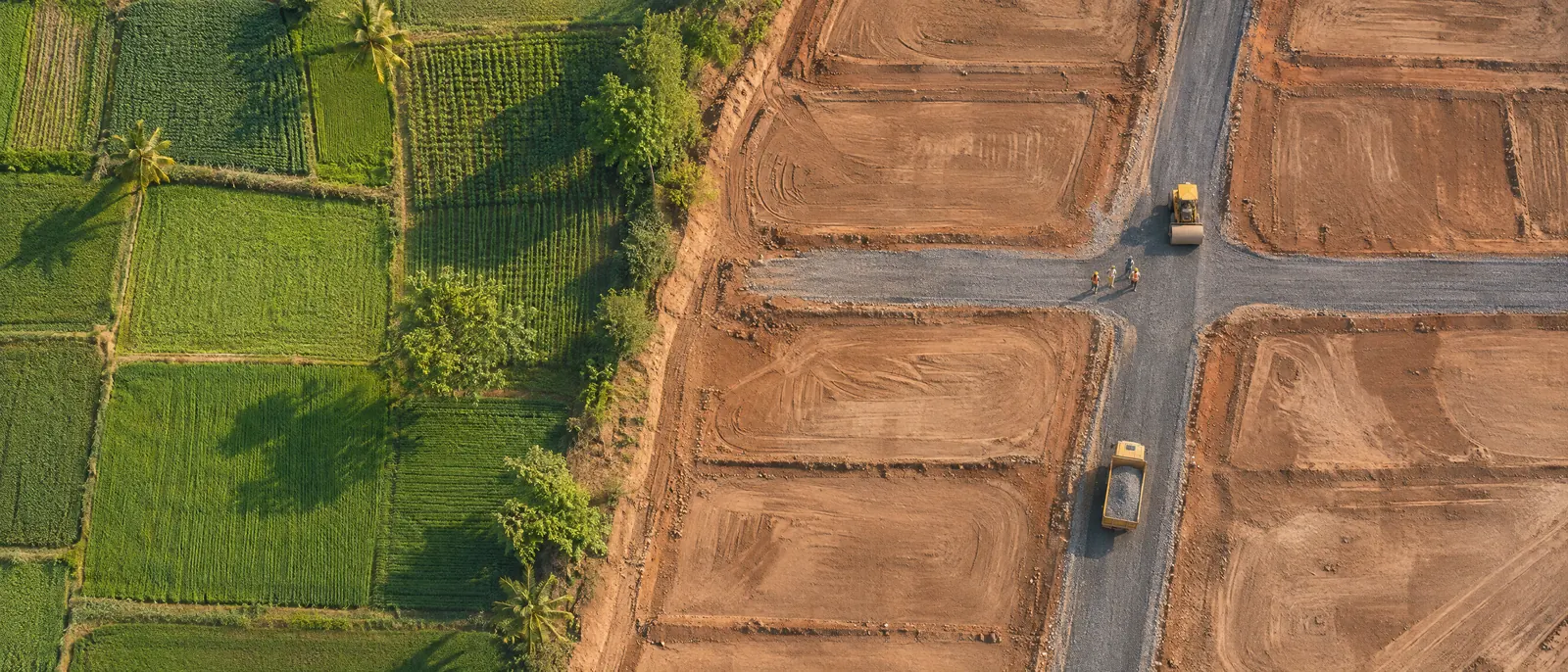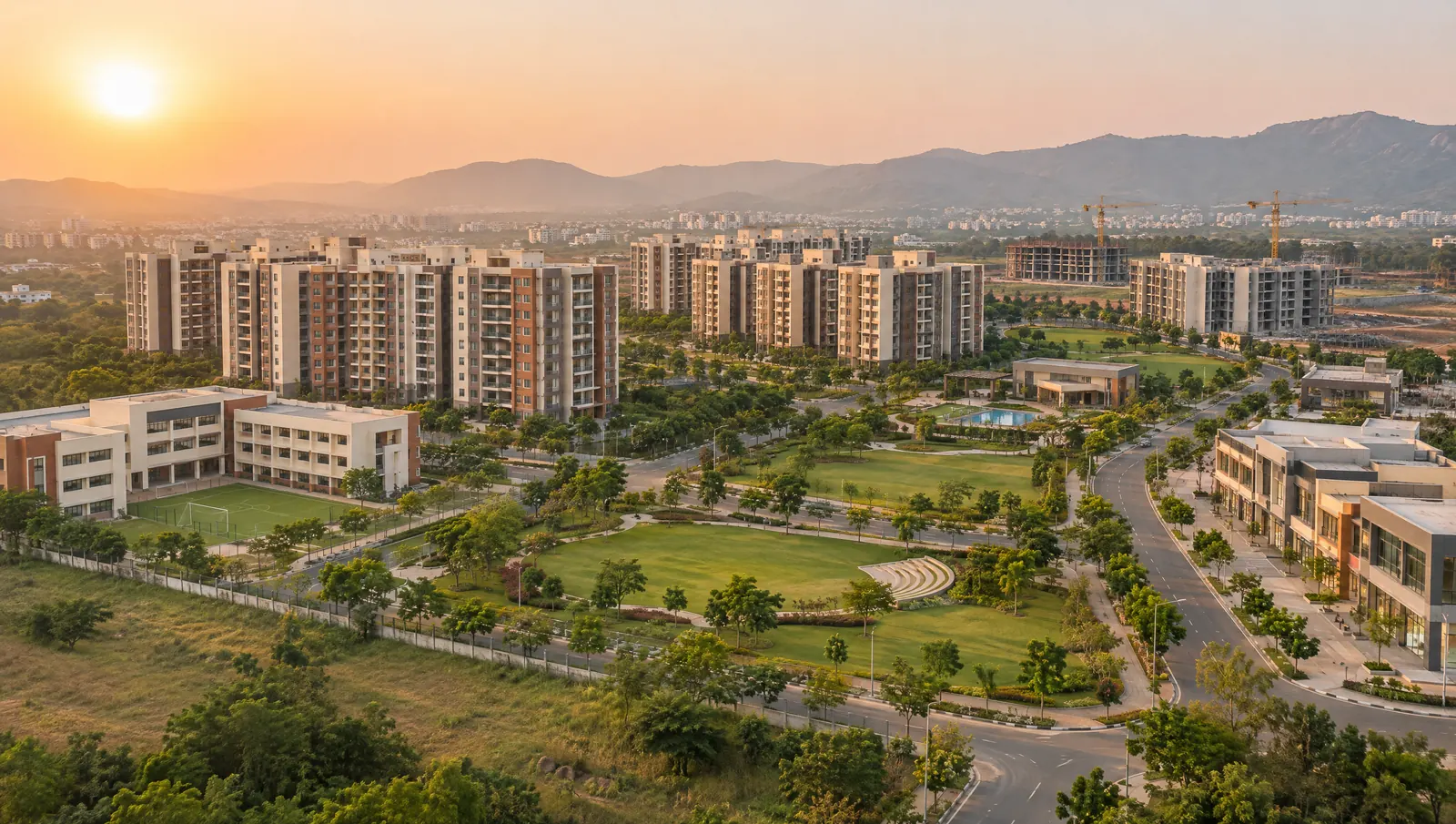
A wellness township is a large planned development that its developer markets as designed to support residents' health, through walkable layouts, parks, clean air and water, places to exercise and meet, and sometimes on-site health services. “Salutogenic” comes from Aaron Antonovsky's theory of salutogenesis: what creates and sustains health, rather than what causes illness. Neither label is a certification, and neither guarantees any feature or health outcome. Schemes such as WELL and Fitwel certify specific features after third-party review. Before you buy, ask what is certified, what is in the sanctioned plan and your agreement, and who will run and pay for it.
A wellness township is a large planned development that its developer says is designed to support residents’ health. The usual ingredients are walkable streets, parks and open space, clean air and water, places to exercise and meet, and sometimes on-site health services. The Global Wellness Institute (GWI), the research body that sizes this market, defines wellness real estate as “built environments proactively designed, built, and operated to support the holistic health of occupants, visitors, and the community”.1
Two things follow. First, “wellness township”, “wellness-led” and “salutogenic” are descriptions, not certifications. Using them does not, by itself, mean a project meets any standard. Second, some features sold as wellness are things the planning rules already require. This guide explains both terms, what the independent standards check, and the questions that tell substance from marketing.
Where “salutogenic” comes from
The word comes from Aaron Antonovsky’s theory of “salutogenesis”, developed in two books: Health, Stress, and Coping (1979) and Unraveling the Mystery of Health (1987). Medicine mostly asks what makes people ill. Antonovsky asked what keeps people healthy. He did not see health as a yes-or-no state. He placed everyone somewhere on a continuum between health and illness, moving with circumstances and life events.2
His central idea is the “sense of coherence”: a person’s capacity to make sense of everyday situations and use the resources around them.2 It has three parts. Applied to buildings and places, design researchers describe them like this:3
- Comprehensibility: clarity and legibility of the environment.
- Manageability: perceived control and mastery of the environment.
- Meaningfulness: connection to place and purpose.
Designers have since tried to turn these into features of places. A 2022 peer-reviewed paper linked comprehensibility to legible, easy-to-navigate places; manageability to acceptable walking distances to everyday amenities, to coping with busy streets, and to residents having a say in decisions about their surroundings; and meaningfulness to pleasant, meaningful experiences of the street. Its authors also noted that Antonovsky’s theory had “not found an explicitly stated practical application in urban design”.2 A 2026 protocol for a systematic review states that evidence on how salutogenic principles are applied in compact homes “remains fragmented”, with no established framework for classifying them.3
So “salutogenic” describes an intention: design that supports health rather than only avoiding harm. It is not a specification you can check off.
What “wellness-led” usually means, and how big the market is
GWI measures the market as spending on properties that incorporate intentional wellness elements in their design, materials and building, as well as their amenities, services or programming. It says its estimate “is not limited to projects that have obtained certifications”.1 In other words, a project does not need a certificate to be counted.
On that basis, GWI estimates global spending on wellness real estate at US$875.6 billion in 2025, and India’s at US$20.5 billion, the 11th largest country market. GWI revised its earlier figures for India and other large Asian markets in this edition, so older numbers are not comparable.1 These are estimates of construction spending. They say nothing about whether residents of any project are healthier.
The standards that do check: WELL and Fitwel VERIFIED
A few independent schemes certify health-related features after a third party reviews them. Two international schemes that publish their criteria are WELL and Fitwel.
| What it covers | How it is checked | Levels | What to watch for | |
|---|---|---|---|---|
| WELL v2 (International WELL Building Institute, IWBI) | Buildings, across ten concepts: air, water, nourishment, light, movement, thermal comfort, sound, materials, mind and community4 | Third-party review, plus on-site performance testing of air, water, sound and light4 | Bronze (40 points), Silver (50), Gold (60), Platinum (80)4 | Precertification is based on plans, with no performance testing. In multifamily housing, Bronze and Silver need no testing inside homes for the mandatory preconditions4 |
| WELL for residential (IWBI) | Homes, including single-family homes, flats in multifamily buildings and communities of homes5 | Third-party review and verification | “WELL Residence”; a project can be “precertified” during design or construction5 | Open for pilot enrolment, per IWBI’s February 2026 guidebook5 |
| WELL Community Standard (IWBI) | Whole communities, beyond individual buildings: 110 features across ten concepts6 | Administered by Green Business Certification Inc. | Silver (50 points), Gold (60), Platinum (80)6 | IWBI’s standard document describes it as a pilot6 |
| Fitwel (Center for Active Design) | Buildings and sites, including a Community Site scorecard for contiguous sites with at least one residential building7 | Review of documentation against 55-plus design and operational strategies, weighted by strength of evidence7 | One to three stars (90 to 144 points)7 | Certification is valid for three years8 |
Fitwel was developed by the US Centers for Disease Control and Prevention and the General Services Administration; the Center for Active Design became its licensed operator in 2016.9
Two points matter most for a buyer. A precertification is a statement about plans, not a finished building: WELL says precertification lets owners “market the proposed features of a project”.4 And certification is not a health promise. IWBI’s residential guidebook says that achieving the award “does not in any way guarantee, represent or warrant” that people in the space will be free from illness or exposure to contaminants.5
No project can promise health outcomes
A design intention or a certificate is not a health result. No township can promise that it will make you, or anyone in your family, healthier. Treat any brochure that promises health outcomes or a longer life as marketing, and ask for the evidence behind the claim.
In Maharashtra’s integrated townships, some “wellness” features are the legal minimum VERIFIED
If a project is approved as an Integrated Township Project under Regulation 14.1 of Maharashtra’s UDCPR 2020, some of what it markets as wellness may simply be what that regulation requires. As sanctioned, the master layout of such a township must provide:10
- gardens and parks of at least 5% of the master layout area, including a town plaza of at least 1,000 m²;
- playgrounds of at least 7.5% of the master layout area;
- a further 10% open space in each sector-level layout;
- space for community health care, such as a dispensary, maternity home or hospital (for a 40-hectare layout, at least 1,000 m² of area and 1,500 m² of built space, scaled up for larger layouts; it can share a building with other uses).
The buildings must also meet a minimum green-building rating. The developer must build and maintain the township’s infrastructure until it is handed over, and may collect maintenance contributions or a corpus from buyers to pay for it.10 In March 2024 the State Government published proposed changes to Regulation 14.1 for public comment and directed, under section 154 of the MRTP Act 1966, that they apply immediately, irrespective of sanction. They leave the open-space and health-care requirements above unchanged, and widen the green-rating options to include an IGBC or LEED Silver rating or an equivalent ASSOCHAM GEM rating.11 Ask a planner which version the authority is applying to the project you are looking at. Our explainer on Maharashtra’s integrated township rules explains the rules and the 2024 changes, and our guide to what an integrated township is explains how it differs from a standalone project.
Other states set their own rules. Within Maharashtra, UDCPR does not apply in Greater Mumbai and some other planning areas, and townships approved under earlier rules may follow different norms.11 Ask whether the project is an Integrated Township Project under Regulation 14.1. Wherever you buy, ask which parks, playgrounds and health facilities the approvals require, and which are extra.
Who is marketing wellness in India
Several Indian developers position whole projects, or their company, on health. Della Townships uses the salutogenic label for its whole business. It describes itself as developing “salutogenic luxury integrated townships”. It says salutogenic living “focuses on what keeps people healthy physically, mentally, and socially”. Its website ties the idea to Antonovsky, and says it emphasises “environments and resources that promote coherence, manageability, meaning, and connection” (all company-stated).12 Those words borrow from Antonovsky: “coherence” is his overall concept, and “manageability” and “meaning” echo two of his three components. “Connection” is Della Townships’ own addition. Like any such description, it states a design intention, not a certified or measured result, so the questions below apply to it in full. When we searched MahaRERA’s register by project name on 27 November 2026, none of the township collaborations Della Townships lists in Maharashtra appeared.13
In a March 2022 press release, Mahindra Lifespaces described the homes in one of its projects as “designed for your complete health” (company-stated).14 In August 2025, Experion Developers and IWBI announced that three of Experion’s residential complexes had received the precertified WELL Residence designation, and said full certification would follow third-party verification once construction was complete.15
We do not rank or endorse any of them. Use the same questions below for every developer, and compare their records on our developer profiles.
Questions to ask before you buy
- Approval route. Is the project approved as an Integrated Township Project, and under which rules?
- Certification. Which scheme, which version and which level? Is it precertified or certified? Ask for the listing in the certifier’s own project directory, not a logo in a brochure.
- Scope. Does the certification cover the whole township, one building, or a show home?
- Plans and paperwork. Is each wellness feature shown in the sanctioned layout, in the project’s RERA registration, and in your agreement for sale, with a completion date? Our step-by-step guide shows how to verify a project on RERA.
- Phasing. Which phase delivers the park, clubhouse or clinic? Is that phase registered yet? Our guide to how a township is masterplanned explains how phases are planned.
- Operations. Who will run the clinic, spa or programmes, under what registrations, and for how long?
- Cost. Is the cost in your maintenance charge, a separate fee, or pay-per-use? What happens to it at handover to the residents’ body or local authority?
- Health claims. What exactly does the brochure promise, and what study supports it?
- Measurements. For air, water and noise, ask for test results, such as a WELL performance verification report, not design intentions.
- Daily life. Walk the actual distances to shops, schools and transport.
- The developer. Check its delivery record on RERA with our due-diligence checklist. It is written for landowners, but the RERA checks work for buyers too.
If the brochure turns out to be wrong VERIFIED
RERA gives buyers a remedy for false advertising. Under section 12, if you pay an advance or deposit relying on a notice, advertisement or prospectus, or on a model apartment, plot or building, and suffer loss or damage because of an incorrect or false statement in it, the promoter must compensate you as the Act provides. If you choose to withdraw from the project, you are entitled to your entire investment back with interest at the prescribed rate, plus compensation.16
Keep dated copies of every brochure, advertisement and web page you rely on. If a wellness feature is central to your decision, ask a property lawyer to make sure it is written into your agreement for sale.
If you are a landowner
Developers pitching a wellness or themed township to a landowner are proposing a particular layout, phasing and set of operating costs, and those choices affect what the land earns. Ask the same questions about certification and operations, and test the developer as you would for any partnership. Our guide to developing 100 acres sets out the stages, from title to RERA registration.
- Global Wellness Economy Monitor 2026 (Nov 2026), Chapter 3, Wellness Real Estate, pp.51–59, incl. Figures 3.1, 3.2 and 3.5 and the definitions section, Global Wellness Institute. Accessed 27 Nov 2026.
- Brunelli L., Smith H., Woolrych R., “A salutogenic urban design framework: the case of UK local high streets and older people”, Health Promotion International 37(5), daac102, 2022 (peer-reviewed, open access; cites Antonovsky 1979 and 1987), Oxford University Press (via PubMed Central, PMC9600453). Accessed 27 Nov 2026.
- Asadi N. et al., “What is the impact of salutogenic design elements on human well-being in microhousing? A systematic review protocol”, BMJ Open 16:e118472, 2026, BMJ Publishing Group (via PubMed Central, PMC13374487). Accessed 27 Nov 2026.
- WELL Building Standard version 2 (WELL v2), Q2 2025 edition: introduction, performance verification, scoring and certification levels, precertification, International WELL Building Institute. Accessed 27 Nov 2026.
- WELL for residential guidebook (published Feb 2026): introduction, precertification and disclaimer, International WELL Building Institute. Accessed 27 Nov 2026.
- WELL Community Standard (pilot), standard document, © 2020: “Using the WELL Community Standard” and certification levels, International WELL Building Institute. Accessed 27 Nov 2026.
- Fitwel: Project Solutions (scorecards, star rating point bands, strategies), Center for Active Design (Fitwel). Accessed 27 Nov 2026.
- Fitwel: Certification (eligible project types, fees, three-year validity and recertification), Center for Active Design (Fitwel). Accessed 27 Nov 2026.
- “Translating Public Health Research into Practical Design Strategies for Healthy Living”, 11 Apr 2018, by a Center for Active Design researcher (blog post on a US government site; secondary), Office of Disease Prevention and Health Promotion, US Department of Health and Human Services. Accessed 27 Nov 2026.
- UDCPR 2020, Regulation 14.1 (Integrated Township Project), as sanctioned 2 Dec 2020: Reg. 14.1.1.7(iii) Tables 14 C and 14 E and Note 1 under Table 14 H; Reg. 14.1.1.10(iii) (maintenance and handover of infrastructure) and (iv)(n) (green rating), Urban Development Department, Government of Maharashtra (copy hosted by GRIHA). Accessed 27 Nov 2026.
- Notice No. TPS-1821/452/CR-105/2022/UD-13, 5 Mar 2024, under ss.37(1AA)(a) and 20(3) of the MRTP Act 1966, proposing changes to UDCPR Regulation 14.1, with directives under s.154(1) that they come into force immediately, irrespective of sanction; recital on where UDCPR applies; Schedule A items 6 and 8 (scanned image), Urban Development Department, Government of Maharashtra. Accessed 27 Nov 2026.
- Della Townships India, website home page and FAQ 2 (company-stated; not linked because the page carries marketing claims), Della Townships India. Accessed 27 Nov 2026.
- MahaRERA registered-project search, project name “Della”, Maharashtra, 27 Nov 2026 (two results; neither carries the name of any township collaboration Della Townships lists), MahaRERA. Accessed 27 Nov 2026.
- Mahindra Lifespaces press release on health-focused homes, 31 Mar 2022 (ANI press release, republished by ThePrint; company-stated), ANI / ThePrint. Accessed 27 Nov 2026.
- Experion Developers and IWBI joint press release on precertified WELL Residence designation, 20–21 Aug 2025 (company-stated), CSRwire. Accessed 27 Nov 2026.
- Real Estate (Regulation and Development) Act 2016, s.12 (statute text, unofficial copy), Indian Kanoon. Accessed 27 Nov 2026.
This guide explains how these structures generally work. It is not legal or tax advice for your situation. Report an error · Editorial policy