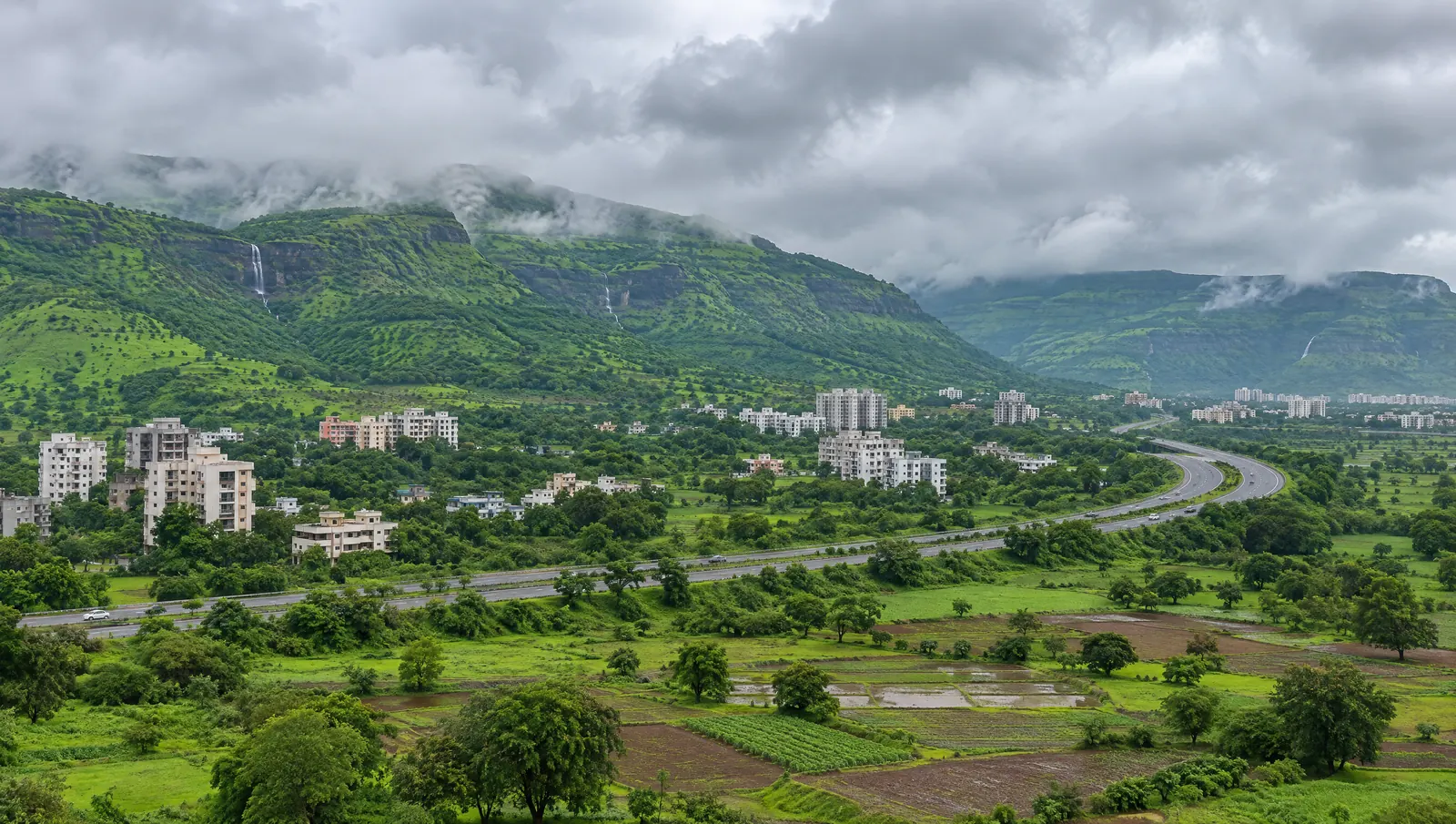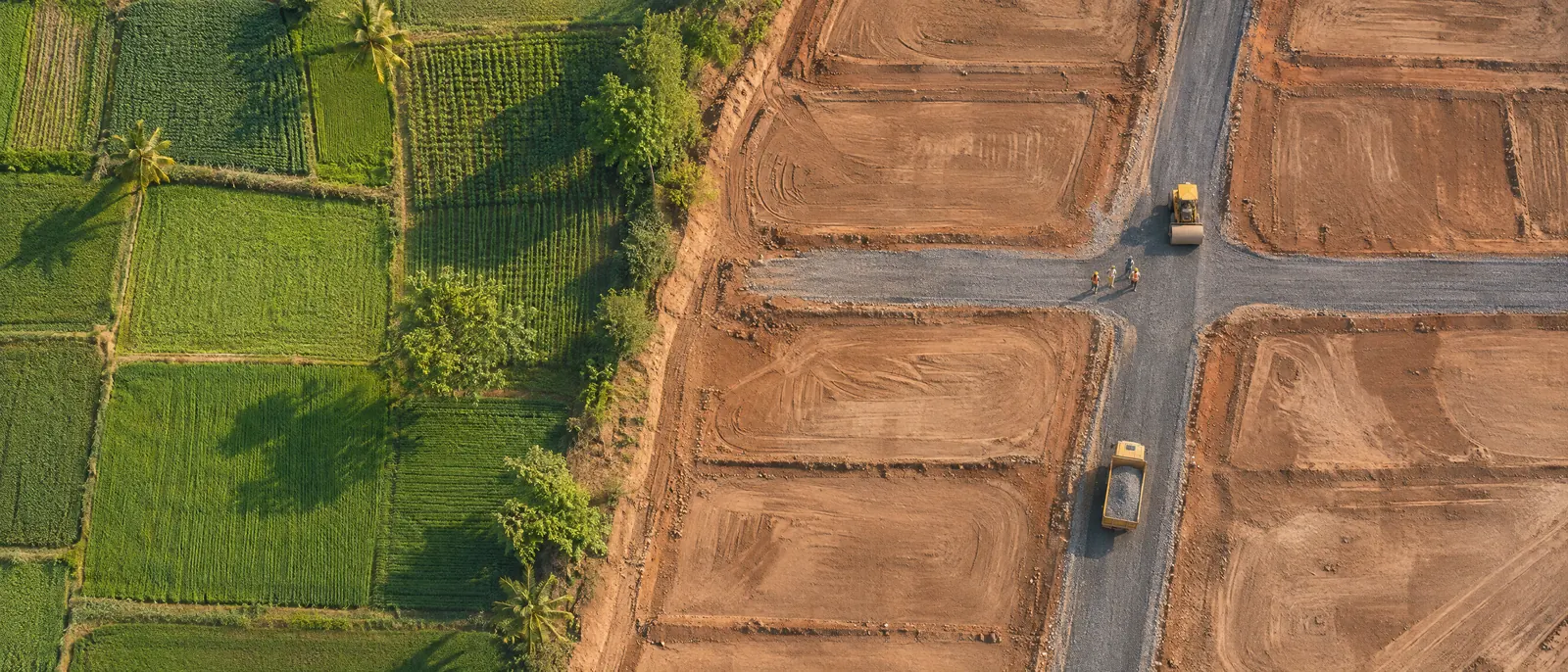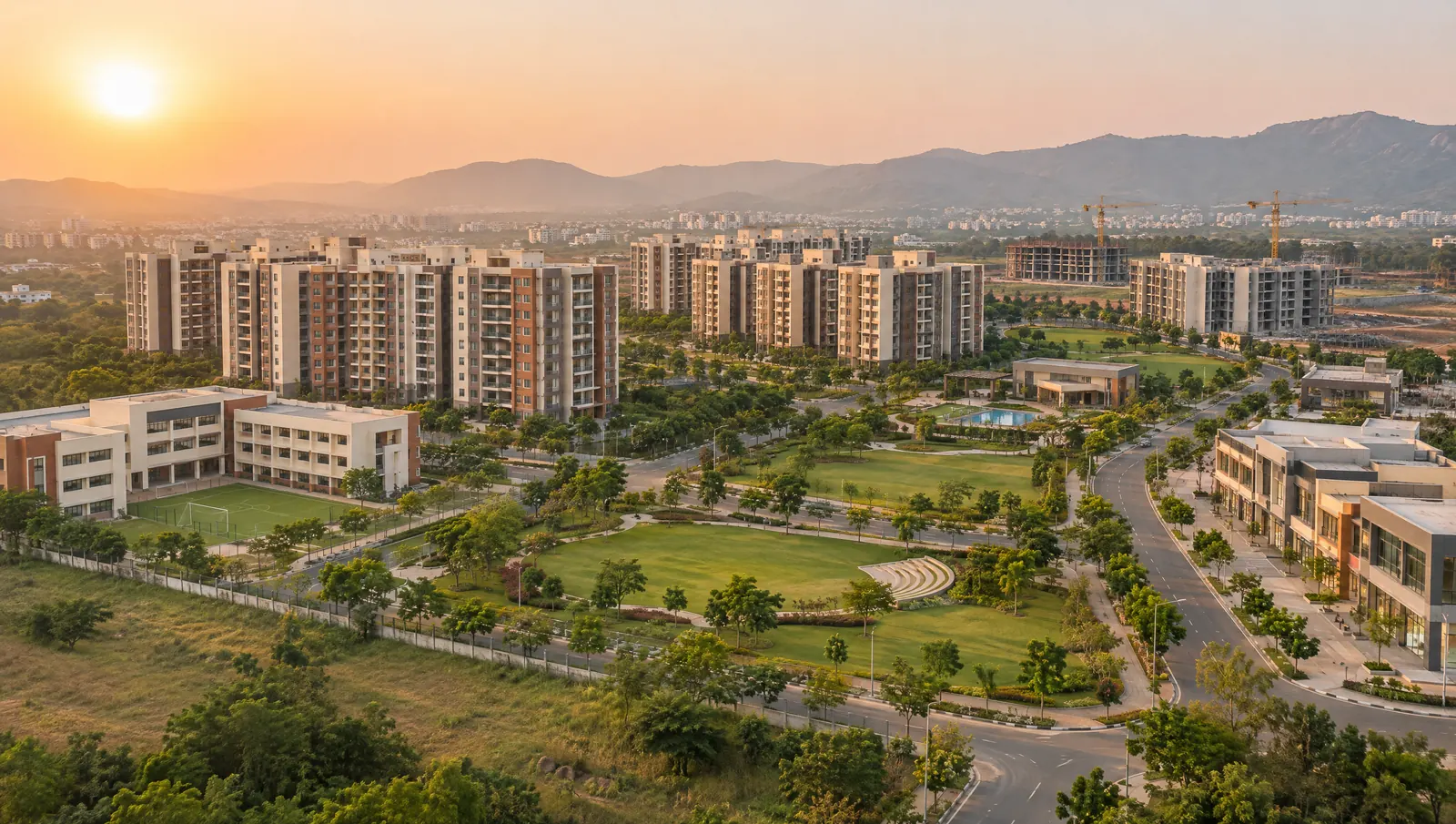
An integrated township is a large planned development that puts homes, jobs, schools, health care, shops, open space and its own infrastructure inside one boundary. In Maharashtra it is a legal status: the State declares a project of at least 40 hectares (about 100 acres) an Integrated Township Project, and, in most of the state, Regulation 14.1 of UDCPR 2020 sets what it must provide. A standalone project is a building or group of buildings that relies on the surrounding area for those services. For a buyer, the differences are phasing over many years, two layers of maintenance, and who runs the township's infrastructure until it is handed over.
“Integrated township” is used loosely in property advertising. In Maharashtra it also has a legal meaning. A project becomes an Integrated Township Project only when the State Government declares it one, by notification in the Official Gazette, under section 18(3) or section 44(2) of the Maharashtra Regional and Town Planning Act 1966, as the case may be.3 Regulation 14.1 of the Unified Development Control and Promotion Regulations (UDCPR 2020) then sets the terms: at least 40 hectares (about 100 acres) of contiguous land (a township of more than 200 hectares may be split into parcels of more than 40 hectares each, within 5 km of one another), and a project that is “an integrated one with all facilities within the boundaries”, from schools and a health centre to sewage treatment, space for jobs and housing for lower-income families.1
A standalone project is a building, or a group of buildings, on its own plot. It may have a clubhouse and a garden, but it relies on the surrounding area for roads, schools, hospitals and work. As a rule, both kinds of project must be registered with the state RERA authority before anything is advertised or sold. The Act exempts projects on 500 m² of land or less, or with eight apartments or fewer, counting all phases; a state government may set lower thresholds.4 What differs for a buyer is scale, time and who runs what. This guide uses Maharashtra’s rules, which we checked on 27 November 2026. Other states have their own.
What makes a township “integrated” VERIFIED
The legal status dates from 2005, when an amendment to the planning Act let the State declare a “Special Township Project”. A 2014 amendment, in force from 22 April 2015, renamed it an “Integrated Township Project”, which section 2(13D) of the Act now defines as a project declared under section 18 or section 44.3
Under UDCPR 2020, all on-site infrastructure is mandatory: internal roads, the approach road, street lights, water supply and drainage. The developer must build it and maintain it.1 The master layout must also set aside land and built space for town-level amenities. For a 40-hectare layout, the minimums are below. The built-space figures for schools, health care, markets and the town hall assume an FSI of 1.0 and rise or fall in proportion if the township’s FSI is higher or lower.
| What | What the regulation requires |
|---|---|
| Open space | Gardens and parks of 5% of the master layout area, including a town square of at least 1,000 m²; playgrounds of 7.5%; and a further 10% open space in each sector-level layout |
| Schools and health care | 5,000 m² of land and 5,000 m² of built space for schools; 1,000 m² of land and 1,500 m² of built space for a dispensary, maternity home or hospital. Larger townships provide more, in proportion |
| Markets and civic space | A general market and a vegetable market of 1,000 m² each (up to 200 hectares); a town hall or auditorium with a library, on 4,000 m² of land with 5,000 m² built (figures as changed in March 2024) |
| Space for jobs | At least 80,000 m² of built space for economic activities, such as offices, shops, IT, hotels, hospitals and non-polluting industry. Since March 2024 this need not be on a dedicated plot, and a township that buys extra FSI must add built space for economic activities at 10% |
| Public utilities | Sites for a fire station, sewage and solid-waste treatment, a bus station or transport hub, an electricity substation, and a police station and cremation and burial grounds, unless a police station already exists within 1 km or the village already has a cremation or burial ground |
| Social housing | At least 15% of the residential basic FSI built as EWS and LIG homes, a third of them kept for rent |
| Services | Drinking water at 90 litres a person a day, not drawn from groundwater; sewage and solid waste treated on site, with zero discharge; at least 10% of the power for common infrastructure from renewable sources; a public transport link to the nearest station or hub; a 3 m cycle track network; 150 indigenous trees a hectare; a GRIHA 3-star, IGBC or LEED Silver, or equivalent ASSOCHAM GEM rating |
Source: UDCPR 2020, Regulations 14.1.1.7, 14.1.1.9, 14.1.1.10 and 14.1.1.12, as sanctioned in December 2020, and the changes directed in March 2024.12 The size threshold, approvals and concessions are covered in our guide to Maharashtra’s integrated township rules. To convert hectares to acres or guntha, use our land-unit converter.
The March 2024 changes were published as a proposed modification of Regulation 14.1, with a direction from the State Government under section 154 of the planning Act that they apply immediately, before final sanction. As of 27 November 2026 we found no later notification sanctioning or changing them.2
Where these rules apply VERIFIED
- Most of Maharashtra. UDCPR 2020 applies across the state except Greater Mumbai, MIDC, NAINA and Jawaharlal Nehru Port Trust areas, hill-station municipal councils, Lonavala Municipal Council, and eco-sensitive regions notified by the Union environment ministry.1
- Some authorities have their own township rules. The March 2024 notice says its changes also apply to the township provisions in the regulations of NAINA, CIDCO, MSRDC and PMRDA, and that the rest of those provisions continue.2 For the Pune side, see our Pune west guide.
- Older townships may follow older rules. A special township or integrated township that already had a locational clearance or letter of intent under earlier regulations may continue under them, or may apply for a revised clearance under the current rules.12 So ask which regulations your township was approved under.
- Other states. They set their own minimum sizes, approvals and maintenance terms, so check the current rules in the state where you are buying.
Township or standalone project: the differences that matter to a buyer
| Integrated township (Maharashtra, UDCPR 14.1) | Standalone project | |
|---|---|---|
| Legal status | Declared by the State in the Official Gazette | No declaration; approved under the general building rules |
| Size | 40 hectares or more of contiguous land; above 200 hectares, it may be in parcels of more than 40 hectares within 5 km | Any size |
| What is inside | Homes plus jobs, schools, health care, markets, utilities and social housing | Homes and the project’s own amenities |
| Roads | Development-plan and regional-plan roads, and the main, arterial and ring roads, stay open to the public | As the sanctioned plan provides |
| Time to finish | Built in phases; the whole township is due within 10 years of master-plan approval, or longer if the Government allows | As stated in each RERA registration |
| RERA | Each phase registered separately, with its own completion date | The same rule applies to any project built in phases |
| Who maintains what | Your building or phase: its association, once formed. Township infrastructure: the developer, until it is handed over after the whole project is complete | The promoter, until the association of allottees takes over |
Sources: UDCPR 2020, Regulations 14.1.1.2, 14.1.1.7(iii)(h), 14.1.1.10 and 14.1.1.12(viii); RERA Act sections 3, 11(4) and 17.14
A township cannot close its main roads to the public. The regulation says its development-plan and regional-plan roads, and its main, arterial and ring roads, are always open to the general public, whether or not they live in the township. Under the March 2024 changes, public reservations inside a township may be shifted, preferably to the boundary, so that the public can reach them without entering the township.12
Phases and RERA VERIFIED
A township is too large to build at once. The whole of it is due within 10 years of master-plan approval, or longer if the Government allows, so early buyers should expect to live beside construction for years.1 The RERA Act treats each phase as a stand-alone project that needs its own registration before it can be advertised or sold.4 That has two consequences for a buyer.
- Your phase’s common areas start with your phase’s land. Where a project is registered phase by phase, the Act defines its common areas starting with the entire land for that phase.4 The clubhouse, school site or park in the brochure may sit in another phase, or in the township’s own infrastructure. Ask where each promised amenity sits and when it is due.
- You are entitled to the schedule. At booking, the promoter must give you the stage-wise schedule for completing the project, including water, sanitation and electricity, and you are entitled to know it.4 The township regulation asks the developer for a phased programme for its infrastructure and amenities when it applies for master-layout approval. Before a part occupancy certificate is issued, the infrastructure must be complete as that programme prescribes; before the certificate for the whole township, all the basic infrastructure in the master layout must be complete.12
Check who the promoters are. In Maharashtra, MahaRERA’s Circular 12/2017 says landowners and investors with a share of the area or revenue are promoters, named at registration, and the agreement between the promoters is uploaded for public viewing.5 Our explainer on when a landowner is a promoter under RERA covers what that means. Our step-by-step guide to verifying a project on RERA shows how to look up a phase’s registration and its promoters.
Maintenance and handover VERIFIED
In any RERA project, the promoter provides and maintains essential services, on reasonable charges, until the association of allottees takes over. The promoter must help form the association, or a federation of associations, and convey the common areas to it or to the competent authority.4
A Maharashtra township adds a second layer: the township’s own roads, water, drainage, street lights and other infrastructure.
- The developer runs it until handover. It must develop and maintain all the infrastructure until it is handed over. It may collect periodic contributions, or raise a corpus fund, from buyers or from bodies of buyers it forms for the purpose.1
- Handover comes late. The developer hands the infrastructure over for maintenance only after the whole project is complete, to the urban local body or other appropriate authority when one is constituted, with any unused corpus.1
- The regulation provides for a local body. The regulation provides for a local authority to be formed for the township under the Maharashtra Municipal Councils, Nagar Panchayats and Industrial Townships Act 1965, according to its population, to take over operation and maintenance with the Government’s approval. If the township is merged into an existing local body, that body takes over.1 The March 2024 changes did not alter these provisions.2
In practice, a township buyer may pay two sets of charges: one to the association of their building or phase, and one towards the township’s infrastructure. How these are split, and which assets go to the association and which to the local body, should be set out in your agreement for sale. Ask your lawyer to check it.
Before you buy in a township
- Is it a declared township? Ask for the Gazette notification of the locational clearance and the approved master layout. If there are none, ask what approvals the project does have. “Township” in an advert is not a legal status.
- Under which rules? UDCPR 2020 with the changes directed in March 2024, an earlier special-township regulation, or another authority’s own regulations.
- Your phase. Its RERA registration number, its completion date, and which amenities are in your phase, in later phases or in the township’s infrastructure.
- The phased programme. What infrastructure is built now, and what is due before your phase’s occupancy certificate.
- The promoters. Who is named on the registration, including any landowner, and what the agreement between them says.
- Maintenance. Who charges for township infrastructure, how the corpus is worked out and held, whether it is separate from your building’s maintenance, and when and to whom it will be handed over.
- Public access. Which roads, parks and amenities will be open to the public.
If you own the land rather than buy into it, our guide on how to develop 100 acres sets out the full sequence from title to RERA registration, and our guide to how a township is masterplanned explains who designs it and in what order.
- Unified Development Control and Promotion Regulations (UDCPR) 2020, title page (applicability) and Regulation 14.1 (Integrated Township Project), incl. 14.1.1.2, 14.1.1.4, 14.1.1.6 (incl. 14.1.1.6(i)(k)), 14.1.1.7(iii)–(iv), 14.1.1.9, 14.1.1.10, 14.1.1.11, 14.1.1.12(iii), (viii)–(ix) and 14.1.1.14, text as sanctioned 2 Dec 2020 (for the changes directed on 5 Mar 2024, see source 2) (unofficial copy), Urban Development Department, Government of Maharashtra (copy hosted by GRIHA). Accessed 27 Nov 2026.
- Government Resolution publishing Notice No. TPS-1821/452/CR-105/2022/UD-13, 5 Mar 2024, under ss.37(1AA)(a) and 20(3) of the MRTP Act 1966, proposing changes to UDCPR Regulation 14.1, with directions under s.154(1) that they come into force immediately; Schedule A items 1–14 and closing note (scanned image), Urban Development Department, Government of Maharashtra. Accessed 27 Nov 2026.
- Maharashtra Regional and Town Planning Act 1966, ss.2(13D), 18(3) and 44(2), with footnotes on Mah. Act 22 of 2005 and Mah. Act 43 of 2014 (text as on 10 Mar 2025), India Code, Government of India. Accessed 27 Nov 2026.
- Real Estate (Regulation and Development) Act 2016, ss.2(n), 3, 4(2)(l)(C), 11(3)(b), 11(4)(d)–(f), 17 and 19(2) (Gazette text, state mirror; unofficial copy), Haryana RERA, Acts page. Accessed 27 Nov 2026.
- MahaRERA Circular No. 12/2017 (4 Dec 2017): land owners/investors having area/revenue share in real estate project to be treated as promoter, MahaRERA. Accessed 27 Nov 2026.
This guide explains how these structures generally work. It is not legal or tax advice for your situation. Report an error · Editorial policy