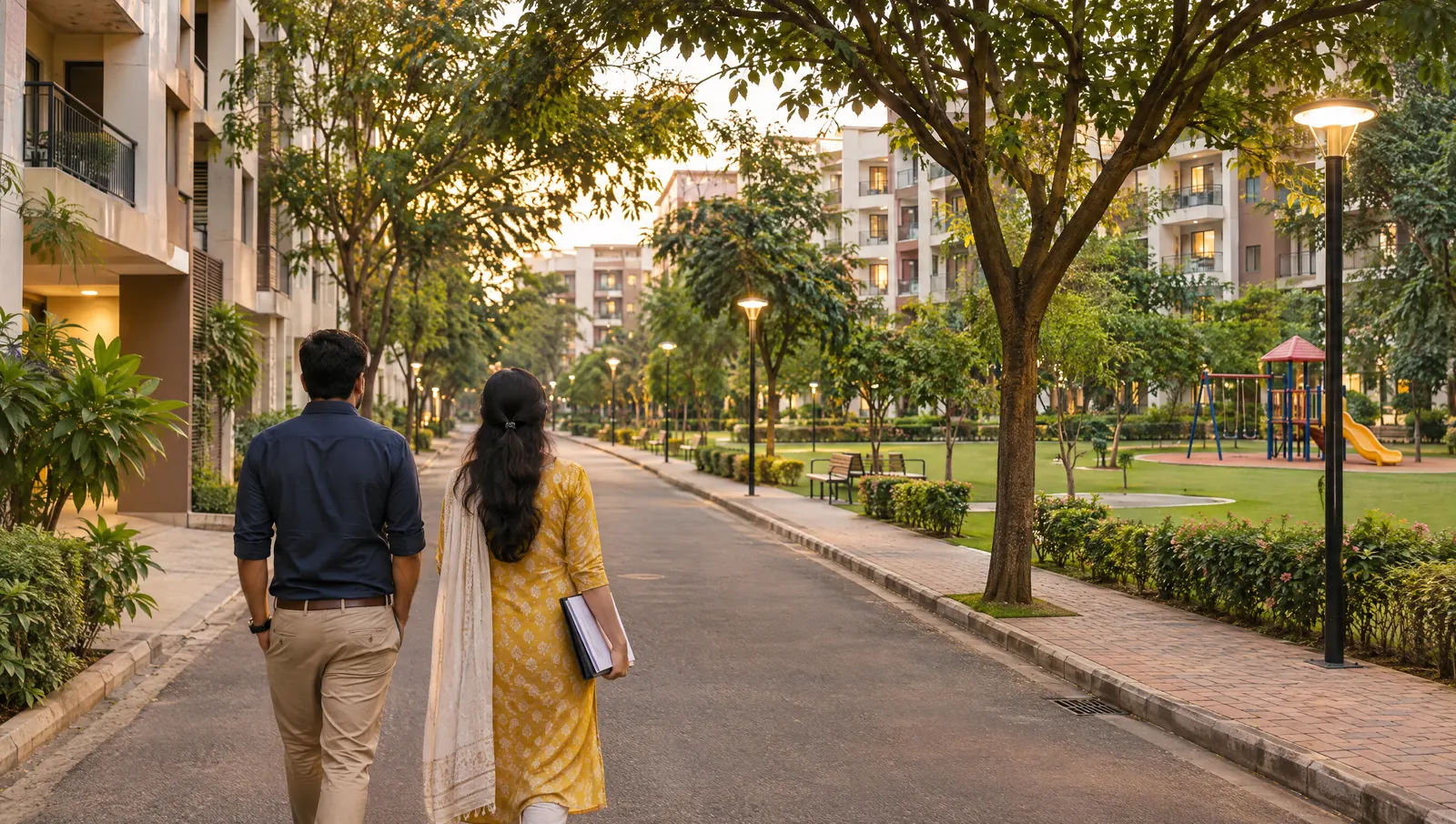
There is no single best township in India: the right one depends on what you need, where, and at what price. A good township is one whose promises you can check: each phase you buy into is registered with the state RERA authority; the developer finished earlier projects close to their declared dates; the approvals, open space and amenities in the brochure appear in the sanctioned plans; it is clear who maintains the roads, water and parks, and when they are handed over; transport links are open, not just promised; and the land's title is clean. Check each on official records before you pay.
There is no single best township in India. “Best” depends on what you need, where you need it and what you can pay. What you can do is test any township against the same seven questions, mostly using records the law requires the developer to publish.1 A township that passes all seven is a good one to consider. One that cannot answer them is not, however good the brochure.
This guide sets out the seven checks, where to find the answer to each, and which of our guides goes deeper. The legal points are national (the Real Estate (Regulation and Development) Act 2016, or RERA). The planning examples are from Maharashtra, whose township rules we checked on 27 November 2026. Other states have their own.
The seven checks at a glance
| What to check | What good looks like | Where to check it | Our guide |
|---|---|---|---|
| 1. RERA registration | The exact phase you are buying is registered, and the details match your papers | The state RERA portal, searched yourself | How to verify a project on RERA |
| 2. Delivery record | Earlier projects and phases finished close to their declared dates, with occupancy certificates | Original and current completion dates on RERA; the five-year history in the registration | How to verify a project on RERA |
| 3. Approvals | Approvals and commencement certificate for your phase, and for the whole layout | The project’s RERA page; the planning authority | How a township is masterplanned |
| 4. Open space and amenities | Every promised park, school and clubhouse is in the sanctioned plan, with a date | Sanctioned plans and layout; your agreement for sale | What an integrated township is |
| 5. Maintenance and handover | Clear charges, a separate corpus, and a date and body for handover | Agreement for sale; the township’s approval conditions | What an integrated township is |
| 6. Connectivity | Roads and transport that are open now, from official sources with dates | The authority building the road or line | Pune west guide |
| 7. Legal title | The promoter’s declared title and encumbrances check out with your own lawyer | The declaration filed with RERA; land records | — |
Sources for the table: RERA Act sections 4, 11, 14 and 19; MahaRERA’s project search; UDCPR 2020 Regulation 14.1.146
1. Is the phase you are buying registered?
VERIFIED
No promoter may advertise, market, book, sell or offer for sale any plot, apartment or building in a real estate project in a planning area without first registering it with the state's RERA authority. Where a project is built in phases, each phase counts as a separate project and needs its own registration. Projects on no more than 500 square metres of land, or with no more than eight apartments across all phases, are exempt, and a state can lower those limits.1That matters more in a township than anywhere else, because townships are built in phases over many years. The registration you see on a hoarding may belong to an earlier phase. Ask for the registration number of the phase, tower or plot you are being offered, and find it on the regulator’s own website, not through a link in a message. Every advert or prospectus the promoter issues must prominently give the regulator’s website address and the project’s registration number (section 11(2)).1 On MahaRERA you can search registered projects and switch to the list of revoked ones; check both.4
The RERA sections in this guide are cited as enacted. The one 2026 amendment we found, by the Jan Vishwas (Amendment of Provisions) Act 2026, changed section 68, on penalties for buyers who do not comply with Appellate Tribunal orders, and none of the sections used here (as of 27 November 2026).23
Our step-by-step guide to verifying a project on RERA shows where to search in Maharashtra, Gujarat and Telangana, and which fields to read.
2. Has the developer delivered before?
VERIFIED
A developer's past is on the record. When it applies to register a project, it must list the projects it launched in the past five years, with their current status, any delay in completion and any pending cases (section 4(2)(b)). It must also declare when it will complete the project or phase (section 4(2)(l)(C)).1- Compare dates. Each MahaRERA result card links to the original application and to an extension certificate where there is one.4 Compare the completion date first declared with the current one, for this project and for the developer’s others.
- Discount blanket extensions. The regulator can extend a registration for force majeure, or for up to a year in total for other reasons where the promoter is not at fault (section 6).1 Some extensions are given to every project at once. Under MahaRERA’s Order 66/2026, registered projects whose completion date fell on or after 28 February 2026 were extended by four months automatically, without any application; projects registered on or after 1 August 2026 are excluded.5 An extension like that says nothing about one developer. Look for extensions a project needed on its own, and for projects still late after them.
- Ask for occupancy certificates. The promoter must obtain the completion or occupancy certificate, or both, from the competent authority and make it available to buyers (section 11(4)(b)).1 Ask for those of the township’s finished phases, and of the developer’s other finished projects. Then visit one and talk to the people who live there.
If a promoter fails to complete or hand over by the date in your agreement, you may withdraw and claim a refund with interest and compensation, or stay and be paid interest for every month of delay (section 18(1)).1 That is a remedy, not a reason to accept a weak record.
3. Is it approved, and approved as what?
VERIFIED
"Township" in an advert is a description. The approvals are what count. A RERA registration must include an authenticated copy of the approvals and commencement certificate for the project, and for each phase where it is built in phases, along with the sanctioned plan, layout plan and specifications of the phase and of the whole project (section 4(2)(c) and (d)). The promoter must then update the list of approvals taken and pending every quarter (section 11(1)(d)).1 Read them on the project's RERA page.In most of Maharashtra, “Integrated Township Project” is also a legal status. Under Regulation 14.1 of the Unified Development Control and Promotion Regulations (UDCPR) 2020, it needs at least 40 hectares (about 100 acres) of land in one contiguous block (a township of more than 200 hectares may be split into parcels of more than 40 hectares each, within a 5 km radius), permission and a declaration from the State Government, a letter of intent from the Collector, and approval of the master layout plan.6 UDCPR does not apply in Greater Mumbai, MIDC, NAINA, Jawaharlal Nehru Port Trust and hill-station municipal council areas, Lonavala Municipal Council or eco-sensitive regions notified by the Union environment ministry.6 Changes the State proposed in March 2024, and directed to apply immediately before final sanction, affect parts of Regulation 14.1, including who exercises some of the Collector’s powers.7
So ask: is this a declared township, under which rules, and where is the approved master layout? If it is not a declared township, ask what approvals it does have. Our guide to how a township is masterplanned sets out the approvals in order, and our guide to what an integrated township is explains what the status requires.
4. Are the open spaces and amenities in the sanctioned plan?
VERIFIED
A brochure can show anything. The sanctioned plan is what the promoter must build. At booking, the promoter must make available the sanctioned plans and layout plans, with specifications, and the stage-wise schedule for completing the project, including water, sanitation and electricity (section 11(3)). You are entitled to that information (section 19(1) and (2)).1- The plan binds the promoter. The project must be built as sanctioned (section 14(1)). Once the plans, amenities and common areas have been disclosed to you, the promoter may not change the plans or specifications of your own unit without your consent, apart from minor changes the Act allows. Other changes to the sanctioned plans of a building or to the common areas of the project need the prior written consent of at least two-thirds of the building’s buyers, other than the promoter (section 14(2)).1
- False adverts have a remedy. If you pay an advance relying on an advert, brochure, prospectus or model apartment and suffer loss because of an incorrect or false statement in it, the promoter must compensate you; if you withdraw, you get your money back with interest, plus compensation (section 12).1 Keep dated copies of what you relied on.
- Some “features” are the legal minimum. A Maharashtra integrated township’s master layout must provide gardens and parks of at least 5% of the layout area, including a town plaza of at least 1,000 m², and playgrounds of at least 7.5%, with a further 10% open space in each sector-level layout.6 The March 2024 changes did not alter these figures.7 A park the law requires is not an extra.
Ask which phase each amenity is in, and when it is due. A clubhouse in a phase that is not yet registered has no RERA registration or declared completion date yet. If it matters to you, ask for it, with its phase and date, to be written into your agreement for sale.
5. Who maintains the township, and when is it handed over?
VERIFIED
In any RERA project, the promoter provides and maintains essential services, on reasonable charges, until the association of buyers takes over, and must help that association to form (section 11(4)(d) and (e)).1 The promoter conveys the common areas to the association or the competent authority within the period local law sets; where there is no local law, within three months of the occupancy certificate (section 17(1)).1 A structural defect, or a defect in workmanship, quality or services, reported within five years of possession must be fixed free of charge within 30 days (section 14(3)).1A township adds a second layer: its own roads, water, drainage and street lights. In a Maharashtra integrated township:6
- the developer must develop and maintain all of it until it is handed over, and may collect periodic contributions or raise a corpus fund from buyers for the purpose;
- it hands the infrastructure over only after the whole project is complete, to the urban local body or other appropriate authority, with any unused corpus;
- the whole township is due within 10 years of master-plan approval, or longer if the Government allows;
- the regulation provides for a local authority to be formed for the township, according to its population, to take over operation and maintenance.
The March 2024 changes did not alter these provisions.7 In practice you may pay two sets of charges for many years: one for your building or phase, and one for the township. Ask how each is worked out, where the corpus is held, who audits it, and who takes over at the end. Your lawyer should check that your agreement for sale says so.
6. Is the connectivity real, and dated?
Distances in a brochure may be measured to roads and stations that are not open yet. Judge connectivity on what is open today, and treat anything else as a target with a date that can move.
- Use the builder of the road or line as your source, not the developer of the township. Note the date of the page you read.
- Know the stage. Proposed, sanctioned, under construction and open are different things. A foundation stone is not a completion date.
- Watch dates move. Pune Metro Line 3 was due in March 2025, according to PMRDA, and opened to passengers in November 2026, according to a news report.89
- Ask what the township itself provides. A Maharashtra integrated township must arrange an efficient public transport link for its residents to the nearest public transport station or hub.67 Ask who runs it, how often, and from when.
Our Pune west guide applies this to one market, with what is open and what is being built, and the source and date for each.
7. Is the title clean?
VERIFIED
With its RERA application, the promoter files a declaration, supported by an affidavit, that it has legal title to the land, with authenticated title documents if the land is owned by someone else, and that the land is free from encumbrances or, if not, the details of them (section 4(2)(l)(A) and (B)).1 Read that declaration. In a Maharashtra integrated township, the developer must own all the land in the project, and ownership includes development rights held under registered development agreements or powers of attorney from the landowners.6 So the promoter may not be the landowner, and several parties may be involved.If you suffer loss because the title is defective, the promoter must compensate you, and that claim is not barred by limitation (section 18(2)).1 Still, a declaration and a remedy are no substitute for your own lawyer’s title search before you pay. The law helps here too: a promoter may not take more than 10% of the price as an advance or application fee without first signing and registering a written agreement for sale with you (section 13(1)).1
Integrated township vs gated community: which is better?
“Gated community” is a marketing term. Neither the RERA Act nor Maharashtra’s UDCPR defines it.16 It usually means a standalone project behind a boundary wall, with its own security and amenities. An integrated township, in Maharashtra, is a declared legal status with a long list of requirements, and it cannot close its through roads: its development-plan and regional-plan roads, and its main, arterial and ring roads, must always be open to the public, whether or not they live there.6 The regulation does not say whether other roads, sectors or buildings inside the township may be gated; ask the developer what the approved layout allows.
| Integrated township (Maharashtra, UDCPR 14.1) | Standalone gated project | |
|---|---|---|
| Legal status | Declared by the State Government | No special status; approved under the general building rules |
| Size | 40 hectares (about 100 acres) or more | Any size |
| What is inside | Homes plus schools, health care, markets, space for jobs, utilities and open space | Homes and the project’s own amenities |
| Main roads | Open to the public | As the sanctioned plan provides |
| Time to finish | Built in phases; the whole township due within 10 years of master-plan approval, or longer if allowed | As declared in its RERA registration |
| Maintenance | Your building or phase, plus township infrastructure run by the developer until handover | The promoter, until the buyers’ association takes over |
| RERA | Each phase registered separately | Each phase registered separately, if built in phases |
Sources: UDCPR 2020, Regulations 14.1.1.2, 14.1.1.4, 14.1.1.7, 14.1.1.10 and 14.1.1.12; RERA Act sections 3, 4 and 11.16
Neither is better in general. A township offers more inside the boundary, but you may live beside construction for years and pay for two layers of maintenance. A standalone project is usually finished sooner, but it depends on the area around it for schools, hospitals, roads and work. Choose on what you need near your front door, and on how long you can wait for it. Then apply the seven checks to whichever you choose.
Themed and wellness townships
Some townships are sold on a theme, such as golf, wellness or nature. The seven checks apply in full, and a theme adds questions of its own: how much land is given over to it, who runs it, and what it costs. Our guides to theme-based luxury townships in India and to what “wellness township” and “salutogenic” mean cover those questions.
Before you pay: a checklist
- Registration: the RERA number of your phase, found on the regulator’s own site, with the promoter, location and phase matching your papers
- Revoked projects: the project and the developer’s other projects checked against the regulator’s list of revoked registrations
- Delivery: original and current completion dates compared, with blanket extensions set aside; occupancy certificates for finished phases
- Approvals: the approvals and commencement certificate for your phase, and the sanctioned layout of the whole project; for a declared township, the declaration and master layout approval
- Amenities: each promised park, school, clubhouse or clinic shown in the sanctioned plan, with its phase and due date
- Maintenance: both sets of charges, the corpus and who holds it, and who takes over the township’s infrastructure and when
- Connectivity: every road or line described as open, under construction or proposed, from the authority building it, with a date
- Title: the promoter’s title declaration and encumbrances read, and your own lawyer’s title search done
- Payment: no more than 10% paid before a registered agreement for sale
- Paper trail: dated copies kept of every brochure, advert and web page you rely on
This is general information, not legal advice. Before you pay a booking amount or sign an agreement, have a property lawyer check the registration, the approvals, the title and the agreement.
- Real Estate (Regulation and Development) Act 2016, ss.3, 4(2)(b)–(d) and (l), 6, 11(1), 11(3), 11(4)(b), (d) and (e), 12, 13(1), 14(1)–(3), 17(1), 18(1)–(2) and 19(1)–(2) (unofficial copy; text as enacted), Indian Kanoon. Accessed 27 Nov 2026.
- TG RERA Circular RC No. D6/3777/2026 (15 Oct 2026): amendment to section 68 of the Act by the Jan Vishwas (Amendment of Provisions) Act 2026 (Central Act 8 of 2026), TG RERA. Accessed 27 Nov 2026.
- RERA section 68 amendment 2026 (secondary), SCC Times. Accessed 27 Nov 2026.
- MahaRERA registered real estate projects search (result cards with 'View Original Application' and extension certificate; Registered/Revoked toggle), MahaRERA. Accessed 27 Nov 2026.
- MahaRERA Order No. 66/2026 (7 Aug 2026): extension of registration of real estate projects due to force majeure under section 6, MahaRERA. Accessed 27 Nov 2026.
- Unified Development Control and Promotion Regulations (UDCPR) 2020, title page (applicability) and Regulation 14.1 (Integrated Township Project), incl. 14.1.1.2, 14.1.1.3, 14.1.1.4–14.1.1.6, 14.1.1.7(iii)(a) Table 14C and (h)(iv), 14.1.1.10(i), (iii) and (iv)(a), 14.1.1.11(iii) and 14.1.1.12(viii)–(ix), text as sanctioned 2 Dec 2020 (unofficial copy), Urban Development Department, Government of Maharashtra (copy hosted by GRIHA). Accessed 27 Nov 2026.
- Government Resolution publishing Notice No. TPS-1821/452/CR-105/2022/UD-13, 5 Mar 2024, proposing changes to UDCPR Regulation 14.1 with a direction under s.154(1) of the MRTP Act 1966 that they apply immediately; Schedule A items 1–14 (scanned image), Urban Development Department, Government of Maharashtra. Accessed 27 Nov 2026.
- Maan Hinjawadi Shivajinagar Metro Line (Pune Metro Line 3): project page (scheduled end date), Pune Metropolitan Region Development Authority. Accessed 27 Nov 2026.
- Pune's Hinjewadi–Shivajinagar metro line opens for passengers today after PM Modi's inauguration (news report, 4 Nov 2026; secondary source), Swarajya. Accessed 27 Nov 2026.
This guide explains how these structures generally work. It is not legal or tax advice for your situation. Report an error · Editorial policy